• India +91-7982319697
  • Email contact@digitalmagma.com

What should an AI SEO agency report before you renew its monthly package?

AI SEO agency reporting: Digital Magma explains evidence for mentions, citations, visits and enquiries, with deliverables to check before renewing.

Digital Magma Blog

AI measurement

What should an AI SEO agency report before you renew its monthly package?

Good AI SEO agency reporting explains what changed, what was measured and what is still unknown. Check that evidence before the next renewal invoice.
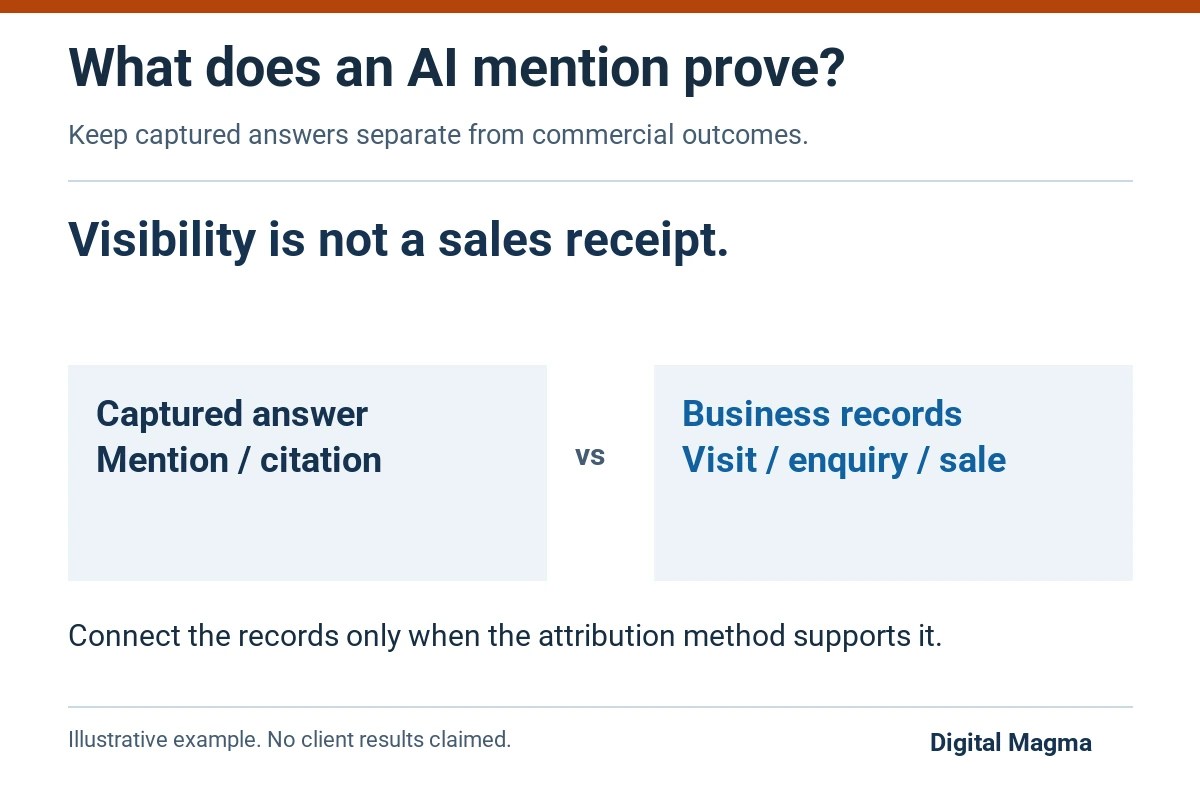
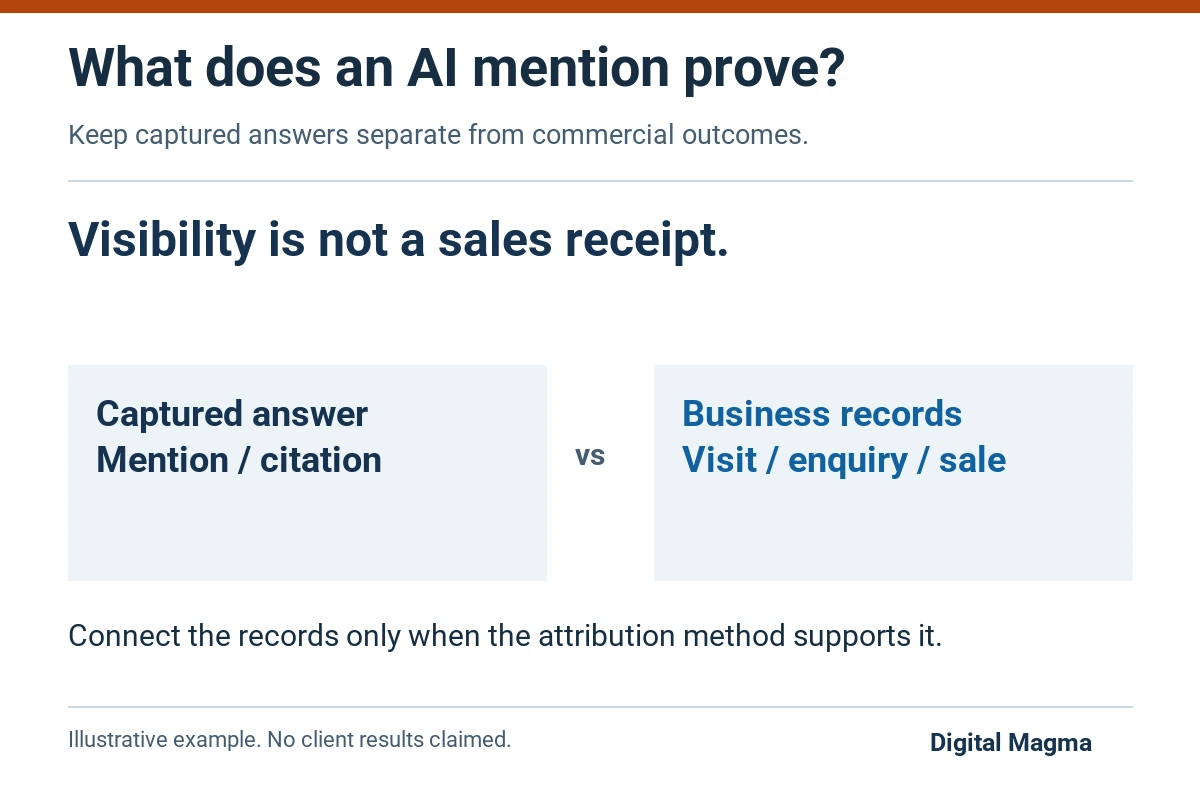
AI mentions and citations are separate from business records of visits, enquiries and sales.
Original Digital Magma diagram. Illustrative example. View full-size diagram.

AI SEO agency reporting should show the questions tested, captured answers and work actually completed. Keep mentions, citations, visits and qualified enquiries separate. Before renewing, compare those results with the original brief and the next proposed task. A rising score needs a visible calculation before it can support your buying decision.

A mention is only the beginning of the story

Your agency sends a chart showing more AI mentions. The sales team has not noticed more enquiries. Does that mean the work failed?

You cannot tell from the chart alone. A mention shows that a captured answer named your business. It does not show whether the reader was a suitable buyer, visited the website or contacted you.

Consider a possible journey: someone sees your company in an AI recommendation, searches for your brand later and then submits an enquiry. Your website analytics may record the search visit without recording the earlier recommendation. That gap matters when you discuss where the customer came from.

This is an illustrative journey, not an observed sequence from our clients. A short “How did you hear about us?” question can add useful context, but a person’s answer is still self-reported evidence.

Use two reporting pages

Keep captured answers and completed agency work on one page. Put visits, enquiries, qualification and sales evidence on the other. Connect them only where you have a defensible method; show the gaps where you do not.
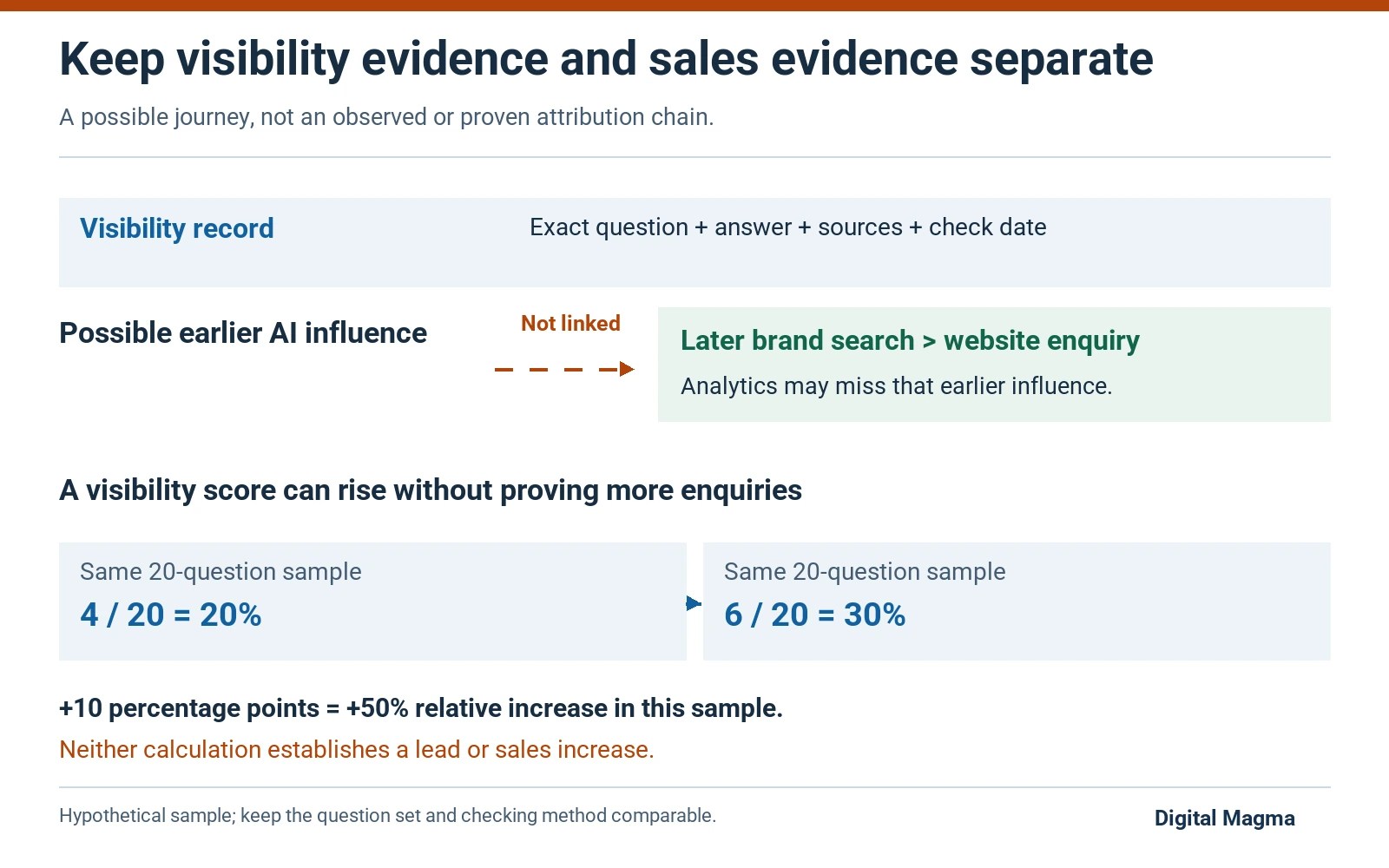
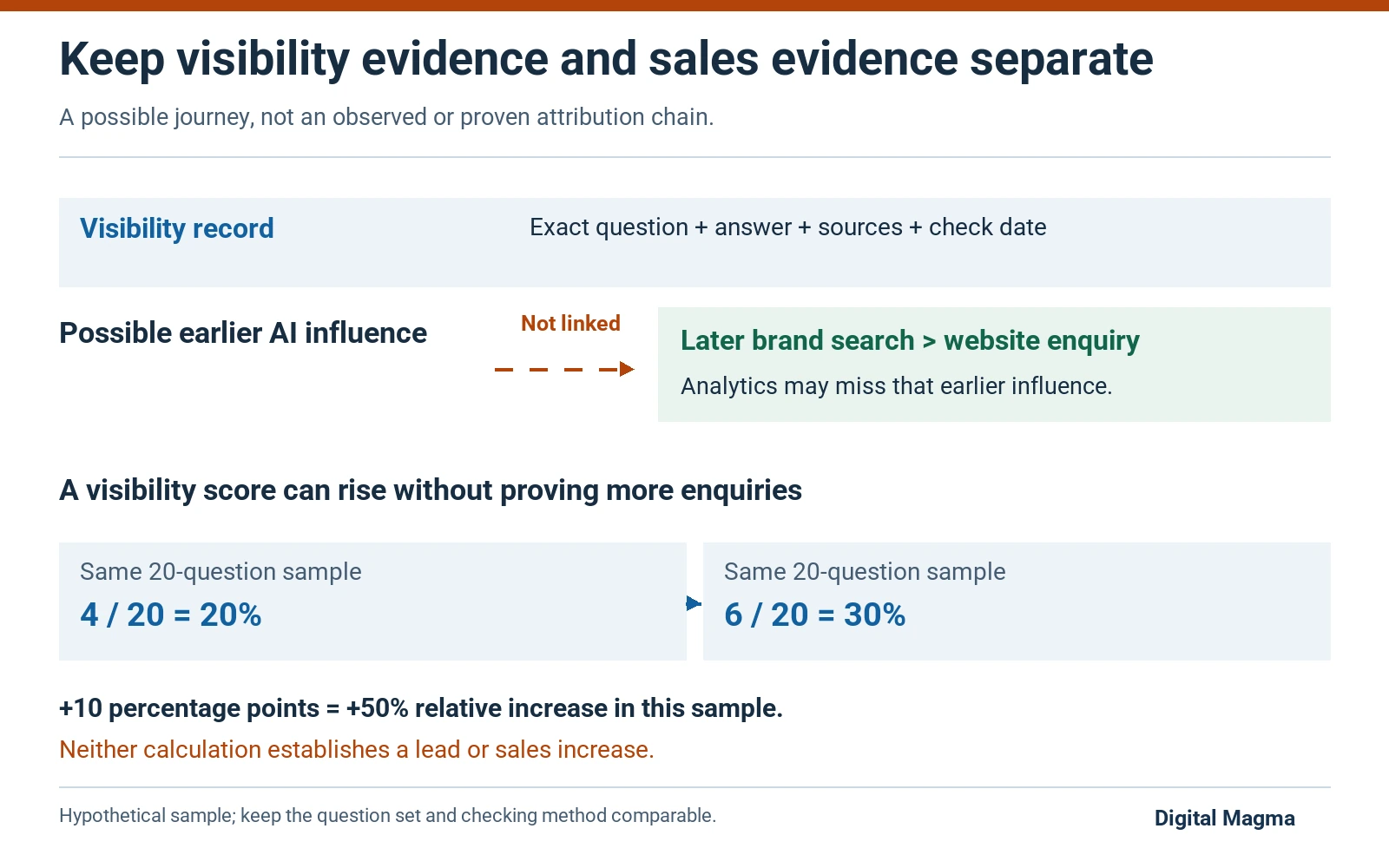
Possible unlinked AI influence before a brand-search enquiry. A hypothetical 20-question sample rises from four mentions to six: 20% to 30%, ten percentage points or 50% relative increase.
Keep attribution gaps visible. The illustrative score increase does not establish a lead or sales increase. View full-size example.

Can you reproduce the question sample?

A useful comparison starts with the same core questions. Changing them every month can improve the percentage without improving the answers buyers actually see.

Keep the exact question, platform, date, language and relevant location context with each capture. Note sign-in or personalisation where it affects the method. If a platform does not expose the model or another detail, label it unavailable.

What the report’s labels should mean
SignalEvidenceLimit
MentionCaptured answer names the businessMay be irrelevant or inaccurate
CitationAnswer links to an identified URLDoes not establish a visit
VisitRecorded session or requestEarlier influence may be missing
EnquiryContact reached the businessStill needs qualification
SaleRecorded commercial outcomeAttribution needs its own method

Keep new questions in a separate group until you have a comparable starting result. “What is SEO?” and “which agency can diagnose our WordPress indexing problem before a redesign?” concern different decisions. A mention for one cannot stand in for the other.

You do not need identical answers on every run. You do need a consistent method that explains repeated checks, missing answers and changes in the platform.

What can Search Console currently show?

Check which Search Console report your property actually has, then read what its numbers count.

Google’s generative AI performance report documentation, checked on 4 October 2026, describes impressions for supported Search AI features. It provides page, country, date and device views. An impression is a displayed link event, rather than a qualified enquiry.

Save the date range and filters with the export. Without them, next month’s comparison can be misleading. Some chart and table totals use different aggregation, so a mismatch should be investigated before it becomes a performance claim. If a report is unavailable in your property, record that fact instead of presenting a guessed total.

This is Google evidence. It does not measure all answers on ChatGPT, Perplexity or other independent services. Ask the agency to label each platform’s evidence separately.

How do you check whether the agency did the work?

Compare the report with the agreed deliverables and a dated change log.

A content task should identify the URL, what was changed and why. A technical correction should show the affected response or setting and its verification. A profile task should show the authorised destination and completed change.

Ask which recommendations remain waiting on your team. A transparent report may show unfinished work because a developer or subject expert has not approved it yet. Hiding that dependency makes next month’s plan less useful.

For a published guide, check the public page, links and author information yourself. Your agency should also be able to explain which assertions came from your team, primary documentation or an explicitly hypothetical example.

Our AI SEO agency selection guide helps put those acceptance checks in the brief before work starts.

What makes a score difficult to trust?

Start with the calculation. Without the number of questions and the actual sample, you cannot tell whether a higher score reflects improved answers or simply a different set of tests.

Suppose a hypothetical report says visibility rose from four mentions in twenty questions to six mentions in twenty questions. That is a change from 20% to 30%: ten percentage points, or a 50% relative increase. Both calculations describe the same sample. Keep those labels clear. “AI authority improved by 40%” means little without the formula, the underlying events and the reason the change matters.

Keep score changes separate from content accuracy. A business mentioned more often with the wrong location or service description has a correction problem even if the graph rises.

Ask how repeated runs, missing answers and changed platform behaviour are handled. The method should make uncertainty visible rather than erase inconvenient results.

What should your renewal decision consider?

Before renewing, check what was finished, whether you trust the evidence and what your buyers still need.

  • Were the agreed tasks delivered and verified?
  • Did the research cover the buyers and questions you care about?
  • Can your team inspect the evidence and access its own accounts?
  • Are enquiries and qualification measured honestly?
  • Does the next plan address a clear remaining problem?

You might renew a useful programme before sales impact is conclusive, especially where measurement is incomplete. State that decision as an investment in defined work, not proof of a return the report cannot establish.

Alternatively, pause the recurring content batch and fund the technical or catalogue task blocking progress. A renewal meeting should leave you with a choice, rather than another chart and an automatic invoice.

Buyer questions

Does one ChatGPT citation prove our campaign worked?

It records one observed citation under the captured conditions. To assess a campaign, compare the agreed sample over time and review completed work, website evidence and commercial outcomes.

Should our brand be mentioned in every answer?

Relevance matters. A question outside your service or market does not become a useful target because your name can be inserted into it. Define the intended buyer questions.

Can an agency promise a permanent AI answer position?

Platforms change responses and retrieval behaviour. Ask for clear delivery commitments and measured observations instead of a permanent-position promise.

Sources and editorial method

Technical claims link to primary documentation in the relevant section. Buying worksheets are Digital Magma’s editorial recommendations. Examples are illustrative, not client results. This guide was prepared with AI assistance; no measured search volume or ranking outcome is asserted. Send corrections through our contact page.

About Ankit Sachan

Ankit Sachan is the founder and Head of SEO at Digital Magma, with 10+ years in search and digital marketing. Read his author profile and the agency approach.

Need a clearer brief for your next agency?

Bring the current report and the work you originally agreed. We can discuss what it establishes, what is missing and the next useful task.

Request an initial website review

Explore AI SEO services, compare SEO packages and read Google reviews.

Call +91 79823 19697 · Email us · WhatsApp

Related buying guides

Google Ads lead quality audit: what should you check before increasing budget?

Google Ads lead quality audit: Digital Magma explains conversion goals, qualification, landing pages and CRM evidence before you increase campaign budget.

Digital Magma Blog

Google Ads

Google Ads lead quality audit: what should you check before increasing budget?

More forms do not necessarily mean more customers. Compare what each campaign spends to produce an enquiry your sales team can actually use.

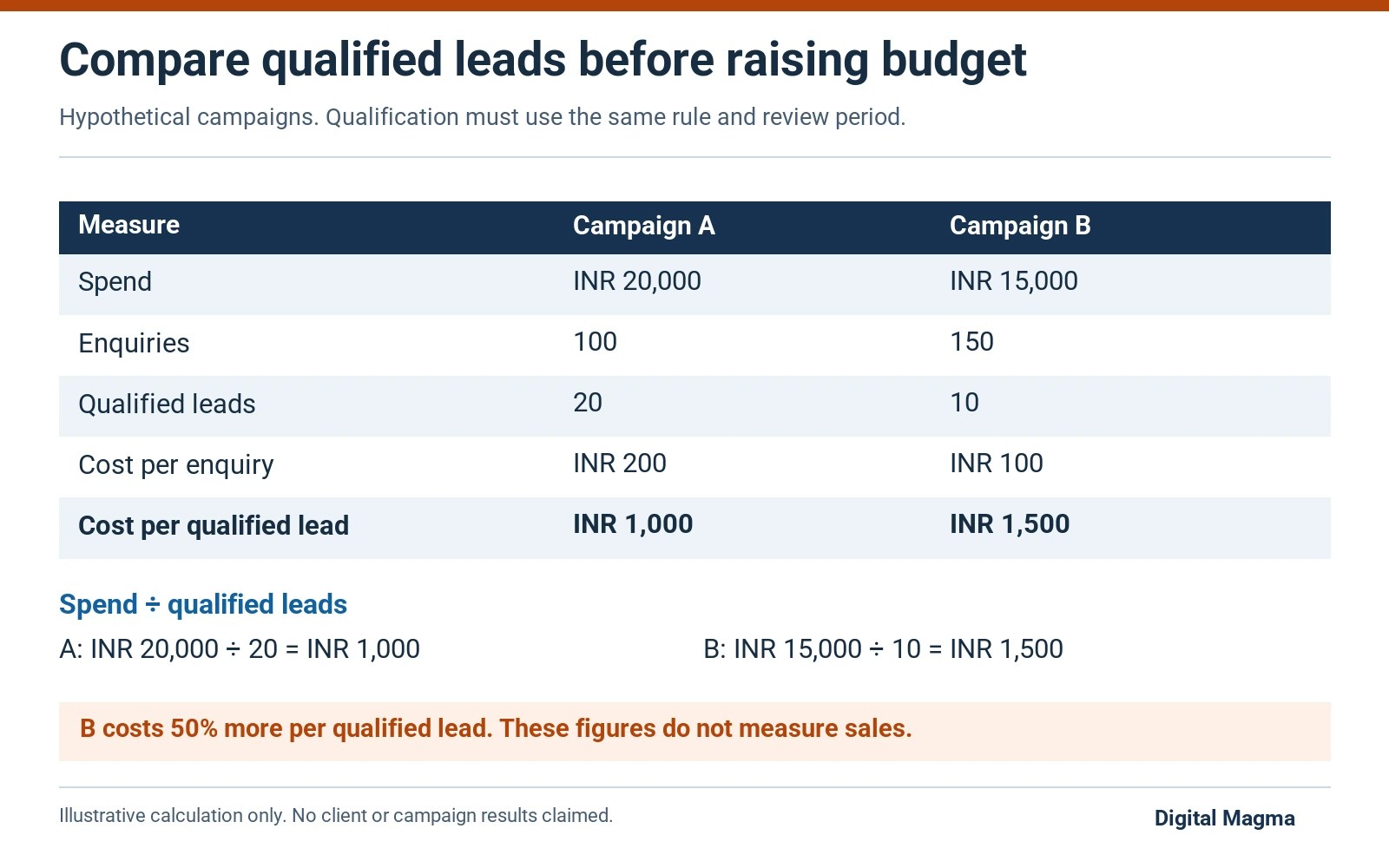
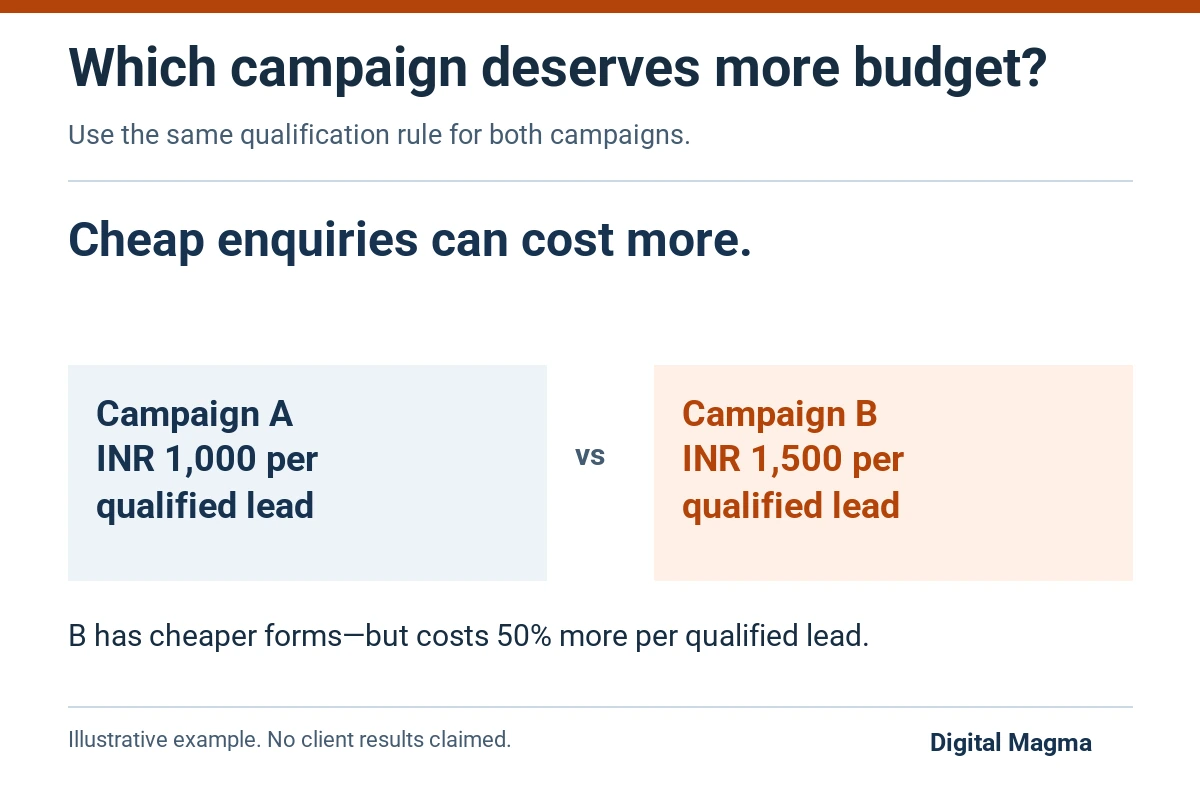
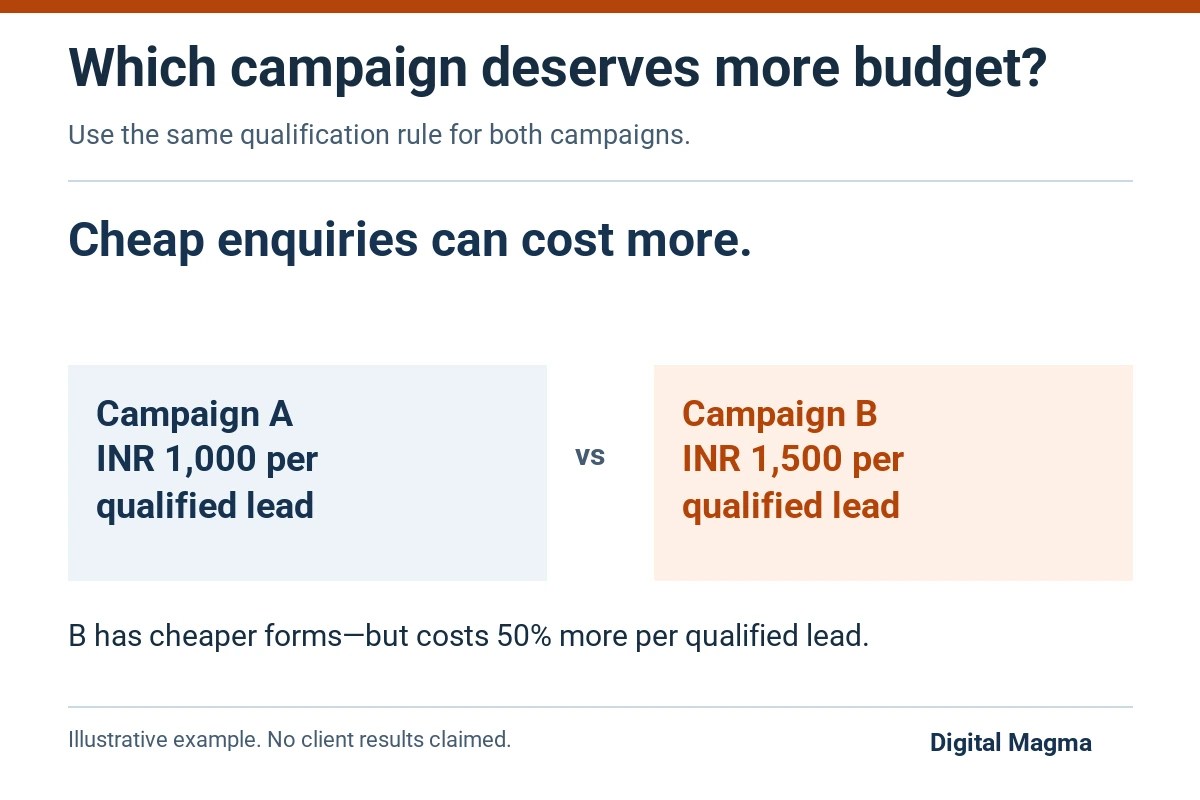
Hypothetical campaign A costs INR 1000 per qualified lead; B costs INR 1500, despite cheaper enquiries.
Original Digital Magma diagram. Illustrative example. View full-size diagram.

Before increasing Google Ads spend, check whether the leads qualify, which actions guide bidding and whether enquiries reach the sales team. Compare cost per qualified lead alongside cost per form submission. More cheap submissions can still leave you paying more for each useful opportunity.

The cheaper form submission can cost you more

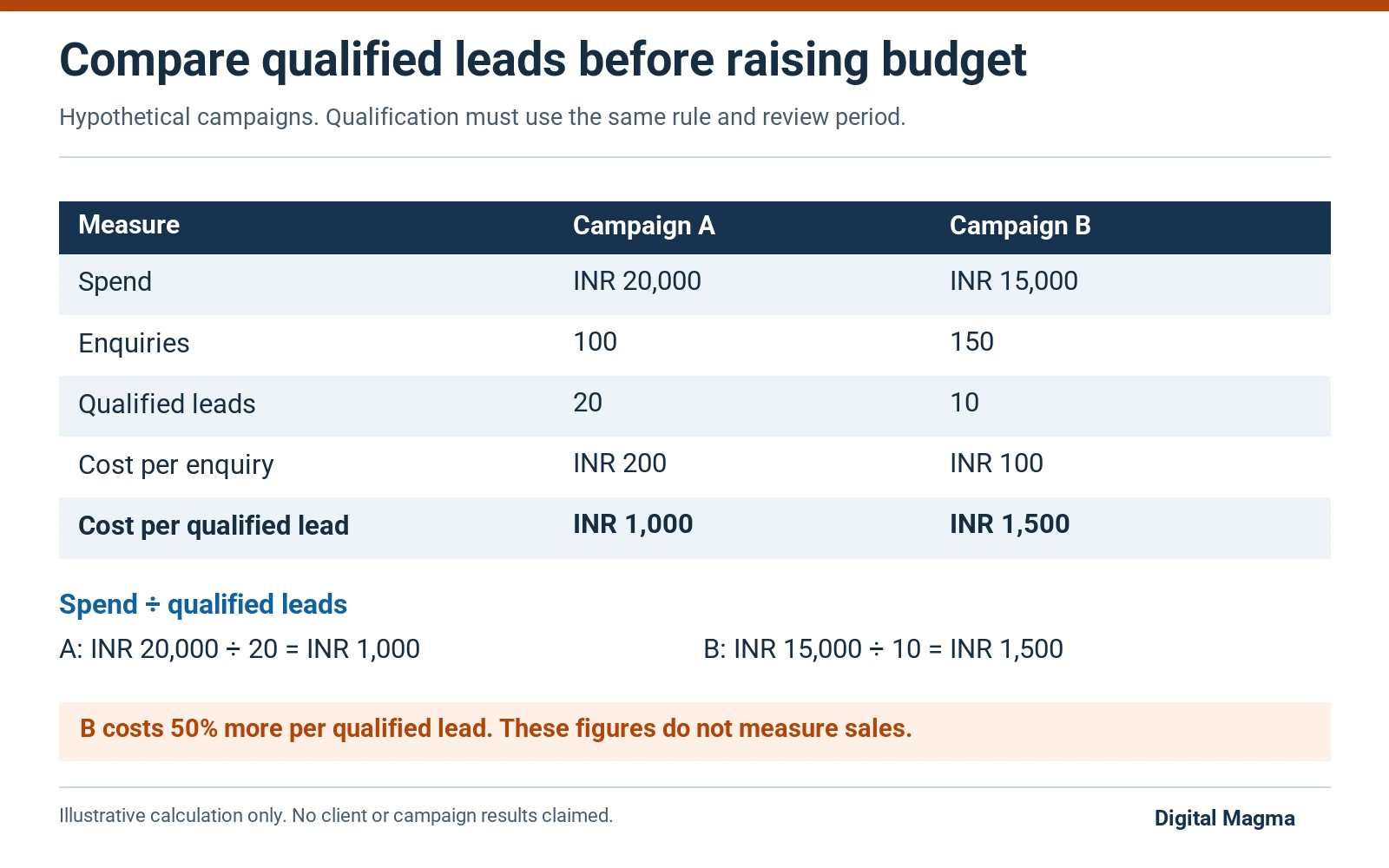
Suppose Campaign A spends ₹20,000 and brings in 100 enquiries. Twenty meet your sales team’s qualification rules. Campaign B spends ₹15,000 and brings in 150 enquiries, but only ten qualify.

Campaign B looks cheaper in a basic lead report: ₹100 per enquiry versus ₹200. Once you compare qualified leads, the result reverses.

Worked example — hypothetical campaigns, same qualification rule
MeasureCampaign ACampaign B
Spend₹20,000₹15,000
Enquiries100150
Qualified leads2010
Cost per enquiry₹200₹100
Cost per qualified lead₹1,000₹1,500

Divide spend by qualified leads: ₹15,000 ÷ 10 = ₹1,500. In this example, B costs 50% more per qualified lead even though its form submissions cost half as much.

This is a calculation, not a campaign result or a promise of improvement. It also does not tell you which campaign produces more sales. That needs a later sales outcome and a consistent way to record it.

Before increasing the budget, find out whether your report can make this comparison at all. If the sales team cannot connect its enquiries to the campaigns, start there.

Hypothetical campaign A: INR 20000 spend, 100 enquiries, 20 qualified leads. B: INR 15000 spend, 150 enquiries, 10 qualified leads. Cost per qualified lead is INR 1000 versus INR 1500.
Campaign B has cheaper enquiries but costs 50% more per qualified lead. The arithmetic uses the table above; these are hypothetical campaigns, not client results. View full-size example.

Which actions are used as bidding goals?

Ask the agency to show the conversion actions and the goals actually applied to the campaign.

Google distinguishes primary and secondary conversion actions. Their role depends on how goals are configured, including custom-goal exceptions. Do not assume that a phone-button click and a qualified opportunity should be rewarded in the same way.

Request a list of action names, sources, counting settings, intended business meaning and campaign usage. Check for duplicate tracking as well as missing tracking. A form event firing twice can distort a result even when every visitor is real.

The useful question is: “What does this account treat as success?” A screenshot of a falling cost per conversion does not answer it.

How do you trace an enquiry through to a sale?

Pick a small sample of recent enquiries you are authorised to inspect. Follow each one from the form or call record into the sales system. Can you find the campaign, the qualification decision and what happened next?

Agree the qualification rule before counting. For a local service business, an illustrative rule might be: needs a service you sell, is in an area you serve and has provided enough contact information for a follow-up. Your sales team must decide its own rule and use it consistently across campaigns.

A duplicate submission should not become two opportunities. A person asking for a job should not be counted as a prospective customer simply because they completed the same form. Keep these reasons in the sales record so the marketing team can see the pattern.

Google’s enhanced conversions for leads guidance explains how first-party outcome information can support measurement. Any integration needs an account-specific review and appropriate data handling.

Test a record arriving once with the intended status. Then establish who handles duplicates and later status changes. A “CRM connected” badge does not answer either question. Keep personal lead details out of public reports.

What can you learn from the search and landing-page evidence?

Look for a mismatch between the buyer’s question and the offer they reach.

A company selling ongoing maintenance may receive requests for a free tutorial if its ads and landing page never make the commercial scope clear. The right correction may be wording and query targeting, rather than a larger daily budget.

Hypothetical lead-quality investigation
FindingQuestion to investigatePossible test
Many requests for an unoffered serviceDoes targeting or page wording suggest it?Clarify the offer and review relevant query evidence
Enquiries from unsupported areasDo location settings and eligibility wording agree?Review targeting and show supported areas clearly
Qualified leads never receive a replyDoes the delivery and follow-up process work?Test routing and record response ownership
Conversions exceed recorded submissionsAre actions duplicated or counting other events?Reconcile events with the form records

A test is a hypothesis, not a promised improvement. Record what changed so you can interpret the next period without mixing several explanations together.

When is more budget a reasonable next step?

Consider increasing spend after the useful outcome is measured and your team can handle more of those enquiries.

Check what a qualified enquiry costs, whether sales can respond and how much data you have. A tiny number of sales cannot justify a confident forecast. Equally, a healthy campaign may be constrained by a slow response process rather than lack of demand.

Use a planning calculation with your own inputs: advertising cost divided by attributed qualified opportunities gives a cost per qualified opportunity for that defined period. It does not prove incremental sales or future performance.

Ask the agency what would invalidate its recommendation. A defensible budget proposal should explain the evidence, assumptions and review point, rather than making a revenue promise from clicks alone.

What should a paid lead-quality audit deliver?

The audit should explain what is wrong, what to change and who will make the change.

  • An agreed qualification definition and a reconciliation sample.
  • A conversion-action and campaign-goal review.
  • Specific query, offer and landing-page findings.
  • Implementation tasks with owners and acceptance checks.
  • A reporting plan that separates submissions, qualified leads and sales.

Clarify whether implementation is included. Ask how sales feedback will reach the person managing the campaign, and whether your team can access the resulting records after the engagement ends.

If the enquiry form or page needs rebuilding, coordinate the audit with a website project scope review. Advertising and website work should use the same definition of a completed enquiry.

Buyer questions

Should we stop all campaigns while investigating?

The evidence should guide that choice. A broken form or misleading offer may justify urgent action; a reporting discrepancy may need a narrower correction. Assess the affected campaigns and business impact.

Is lower cost per lead always better?

Compare the quality definition and later outcomes. A cheaper submission can be less useful if it rarely becomes a relevant opportunity.

Does a conversion integration guarantee better sales?

An integration cannot guarantee sales. It can improve the available measurement signal, but offer quality, demand, qualification and follow-up still affect sales. Test the implementation and evaluate outcomes separately.

Sources and editorial method

Technical claims link to primary documentation in the relevant section. Buying worksheets are Digital Magma’s editorial recommendations. Examples are illustrative, not client results. This guide was prepared with AI assistance; no measured search volume or ranking outcome is asserted. Send corrections through our contact page.

About Ankit Sachan

Ankit Sachan is the founder and Head of SEO at Digital Magma, with 10+ years in search and digital marketing. Read his author profile and the agency approach.

Getting enquiries that rarely qualify?

Bring your campaign totals and the sales team’s qualification rules. We can discuss where the enquiry path needs investigation before more budget goes in.

Request an initial website review

Explore PPC services, compare SEO packages and read Google reviews.

Call +91 79823 19697 · Email us · WhatsApp

Related buying guides

WordPress SEO audit or redesign: what should you buy when pages are not indexed?

WordPress SEO audit or redesign? Digital Magma compares technical fixes, rebuild scope and migration checks when your pages are not indexed.

Digital Magma Blog

Technical SEO

WordPress SEO audit or redesign: what should you buy when pages are not indexed?

A new design will not fix an accidental noindex setting. Diagnose the failing page first, then decide how much of the website needs to change.

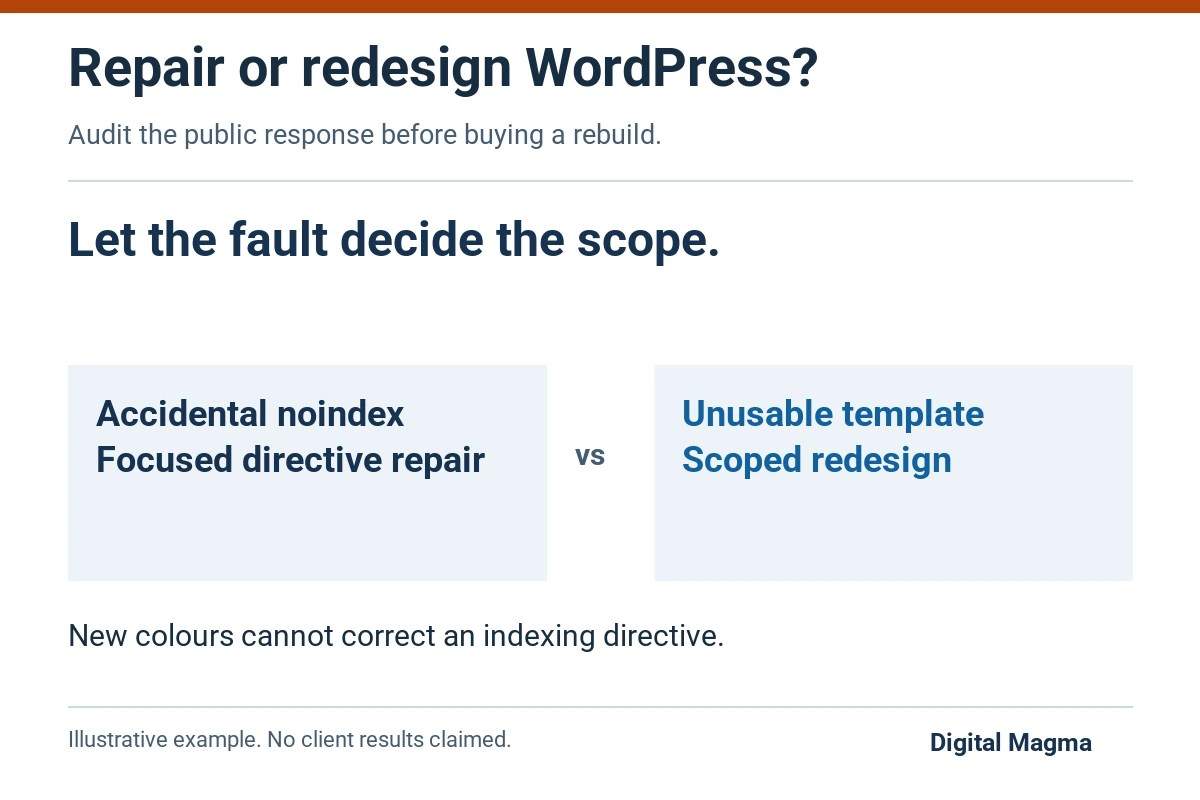
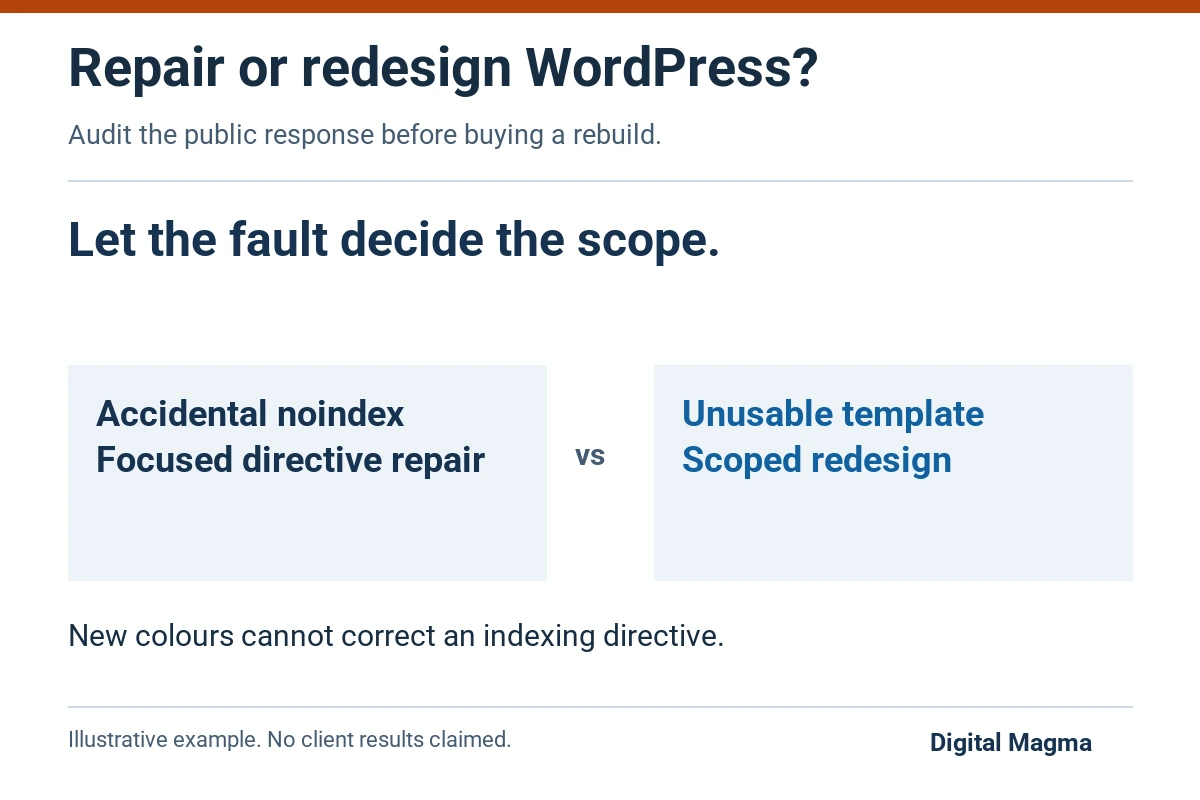
Choose a focused repair for accidental noindex or a scoped redesign for an unusable template.
Original Digital Magma diagram. Illustrative example. View full-size diagram.

Start with a WordPress SEO audit when you do not yet know why a page is failing. A wrong directive or canonical may need a focused repair. A template that cannot support useful content may need redesigning. Diagnose the problem before buying the larger project, and include migration work if URLs will change.

Is the problem a setting or the website itself?

Your WordPress site looks dated and enquiries have slowed down. A redesign sounds like a sensible next step. But if an important service page has an accidental noindex directive, new colours and a better hero image will leave the indexing problem in place.

That is one reason to diagnose the page before buying the project. A focused audit can separate a wrong setting from a template that cannot support the content you need.

Two problems, two different scopes

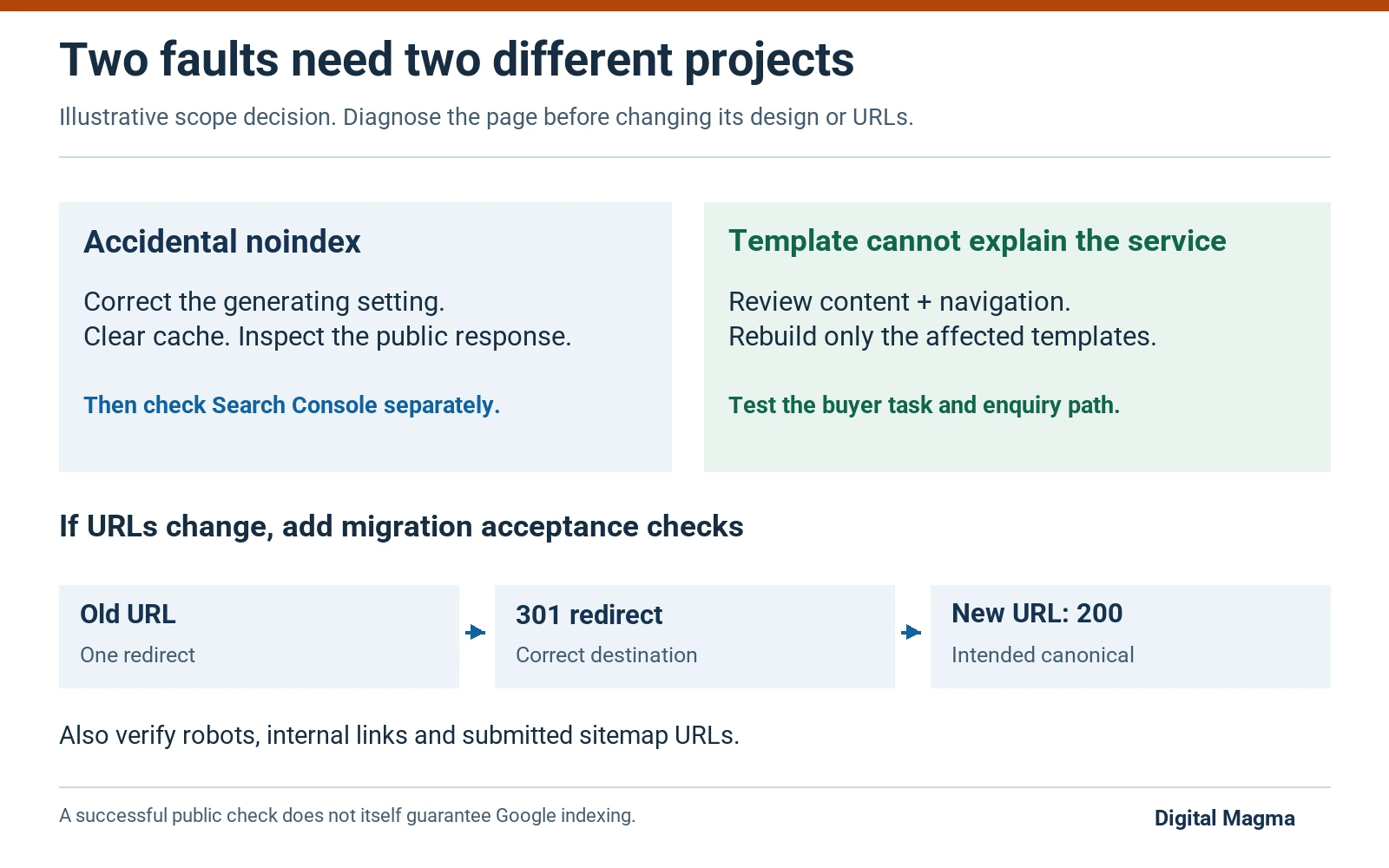
Accidental noindex: correct the setting that produces the directive, clear the relevant cache and inspect the public response. Then check Search Console separately.

Unusable service template: if every page squeezes scope, examples and contact information into an image carousel, changing one setting will not solve the problem. Review the template and the content together.

These are illustrative cases. An audit should establish which one resembles your site, rather than turning every technical issue into a rebuild.

Before the sales call, choose a service page and a contact page. Open both while logged out, read them on a phone and complete a test enquiry. You now have a specific problem to discuss instead of “the site feels old”.

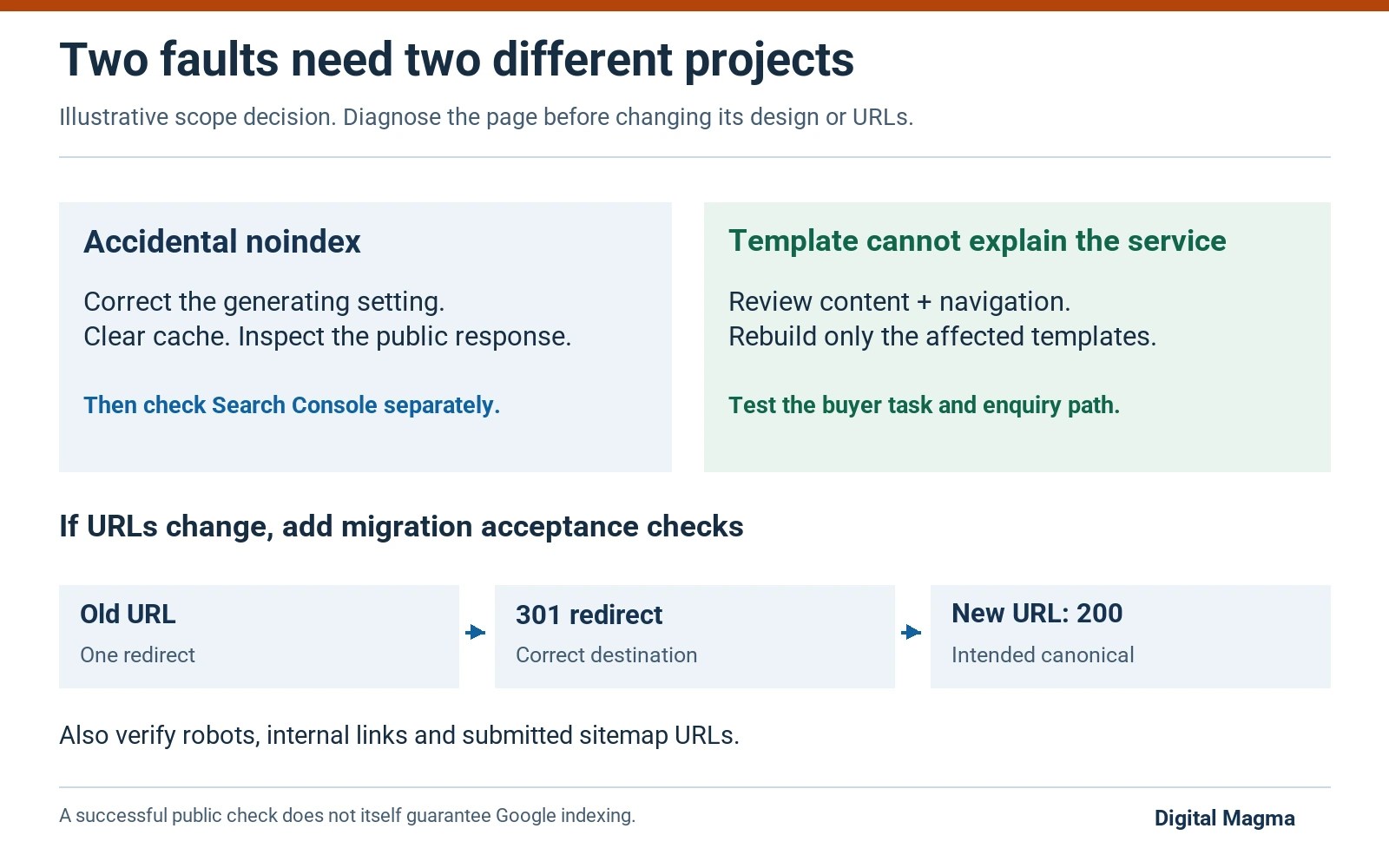
Two illustrative faults need different projects. Correct accidental noindex or rebuild unsuitable templates; if URLs change, verify old URL, 301 redirect and destination 200.
Diagnose the fault before choosing the scope. Include redirect and public-response checks when URLs change. Illustrative cases. View full-size example.

When is a focused technical fix enough?

A focused fix fits a specific fault with a limited area of impact.

Choose the work from the finding
Observed problemFirst project to considerEvidence after the change
Accidental noindex on production pagesDirective and template correctionAnonymous responses show the intended robots setting
Canonicals point to unrelated URLsCanonical generation reviewAffected URLs output the chosen destination
Public copy stays stale after publishingCache and deployment investigationSaved and public content agree
Service details are difficult to navigateInformation architecture and content reviewClear pathways tested with actual reader tasks
Multiple templates need rebuildingScoped redesign with SEO migration planTemplate, URL and enquiry checks pass

These are decision examples. They do not establish that your site has those faults. Ask the supplier to connect the recommendation to a response, page capture or account observation.

When does a redesign make sense?

Choose a redesign when the existing templates cannot support the pages your customers need.

Perhaps important service information is scattered across templates, the mobile contact form is difficult to use, and the editor cannot maintain the content. Replacing those templates may be more useful than repairing each symptom independently.

Separate the visual wish list from the business requirements. Specify the pages that must exist, the tasks readers must complete and the controls your team needs in WordPress. Then ask what must change underneath the design.

Google’s hiring guidance recommends considering SEO early in a redesign. That is a planning point, not a claim that a new design automatically improves rankings.

What should happen to existing URLs?

Keep useful addresses when the redesign does not require them to change. A new layout is not, by itself, a reason to replace every URL.

Where a path must change, agree the destination before launch. Here is a hypothetical map a buyer could ask the developer to demonstrate:

Illustrative URL map — these are examples, not changes to Digital Magma
Current addressLaunch decisionCheck
/services/seo/Keep the existing addressPage works and declares the intended canonical
/old-seo-guide/Move to /seo-guide/Old address redirects to the matching new guide
/retired-offer/Review whether a useful replacement existsNo unrelated homepage redirect by default

The sitemap can miss useful addresses. Check analytics and existing links too, and ask sales which pages they still send to prospects. Save the old content.

Google’s site-move guidance covers URL mapping, redirects, sitemaps and monitoring. Use that process where URLs change; keep a same-address template update scoped to the work it actually needs.

Test the map first. Pick a service URL, an old article and a retired offer, and follow each redirect as a customer would before approving the full list.

How should JavaScript rendering be handled?

Make the main explanation and ordinary navigation accessible without requiring a visitor to trigger an animation or load-more button.

Google can render JavaScript, but its JavaScript SEO documentation describes processing limits and recommends considering server-side or pre-rendered content. For a WordPress service page, ask to see the actual document HTML and the rendered page.

Animation can improve feedback when a menu or accordion opens. It should not hide the service description until a script succeeds. Test an interrupted script load as well as the normal page, especially if the design uses a custom page builder.

Include readable text, meaningful links and accessible controls in the acceptance brief. “The animation looks good on my laptop” is a different test from “a buyer can read the offer and contact us.”

What should you approve before launch?

Who signs off? Agree a release checklist that your developer and SEO consultant can both use, with an owner for each check and a recovery plan if the deployment fails.

  • Old and new URL behaviour, canonicals, robots directives and sitemap output.
  • Mobile and desktop service-page readability, navigation and forms.
  • Important content present in the anonymous response and rendered page.
  • Tracking tested against the intended enquiry actions.
  • Backups, rollback responsibility and a dated deployment record.

Keep delivery acceptance separate from indexing and traffic. The supplier can verify a deployed redirect or working form. Google decides subsequent crawling and index selection.

If your developer and SEO consultant are separate, ask them to share the same checklist. Otherwise, a task can be marked complete by one team while remaining untested by the other.

Buyer questions

Will changing the WordPress theme fix indexing?

A theme change helps only if it addresses the relevant fault. Inspect robots directives, canonicals, content delivery and the page purpose before deciding which code or template needs work.

Should an SEO audit include implementation?

Only when the scope says so. Ask whether the price covers recommendations, deployment, or both, and who will verify each change.

Can a redesign guarantee more enquiries?

A redesign cannot guarantee more enquiries. It can improve a defined user journey, but demand, offer, traffic quality and sales follow-up also affect enquiries. Agree how those outcomes will be measured.

Sources and editorial method

Technical claims link to primary documentation in the relevant section. Buying worksheets are Digital Magma’s editorial recommendations. Examples are illustrative, not client results. This guide was prepared with AI assistance; no measured search volume or ranking outcome is asserted. Send corrections through our contact page.

About Ankit Sachan

Ankit Sachan is the founder and Head of SEO at Digital Magma, with 10+ years in search and digital marketing. Read his author profile and the agency approach.

Unsure whether your site needs a rebuild?

Bring the affected pages and the problem you want solved. We can discuss a focused repair before you commit to a wider redesign.

Request an initial website review

Explore website design services, compare SEO packages and read Google reviews.

Call +91 79823 19697 · Email us · WhatsApp

Related buying guides

What should an ecommerce AI search audit include before you hire an agency?

Buying an ecommerce AI search audit? Digital Magma explains product-page, schema, feed and variant checks, deliverables and an audit acceptance worksheet.

Digital Magma Blog

Ecommerce SEO

What should an ecommerce AI search audit include before you hire an agency?

A store can look correct while its product feed says something else. Use one product to test the audit before you pay for a catalogue-wide project.

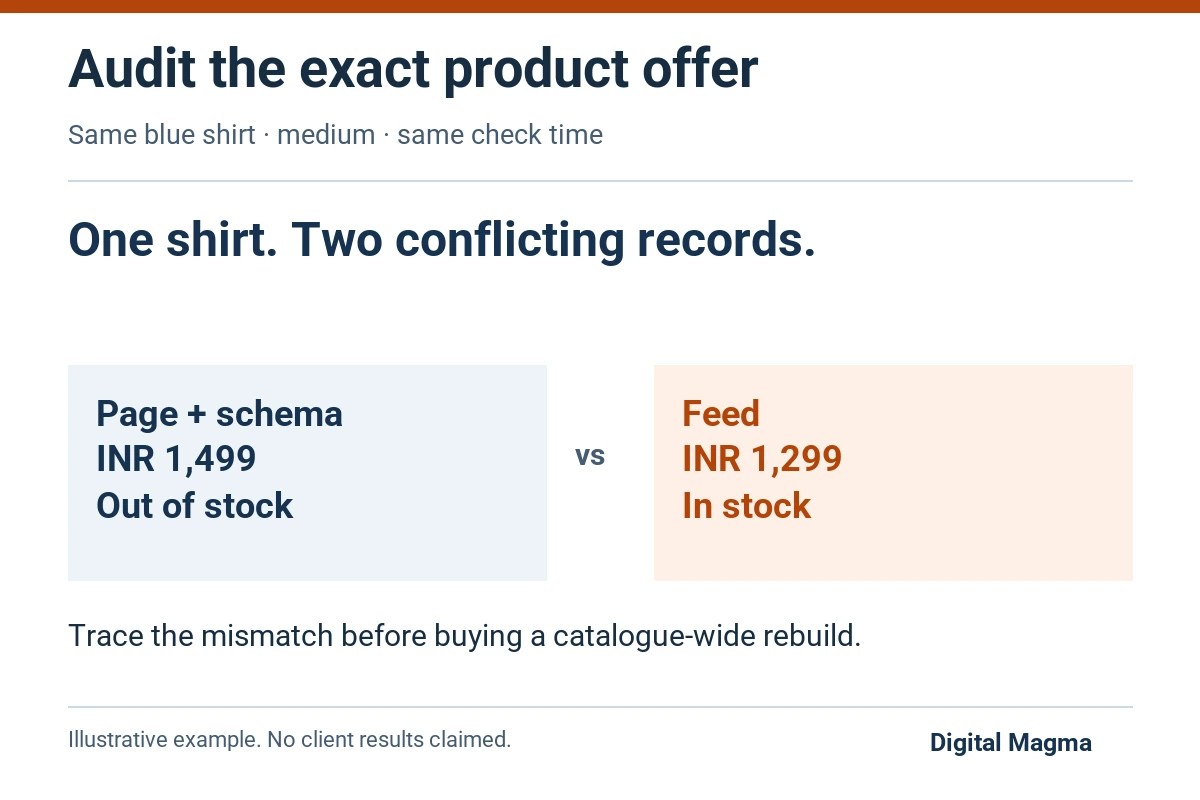
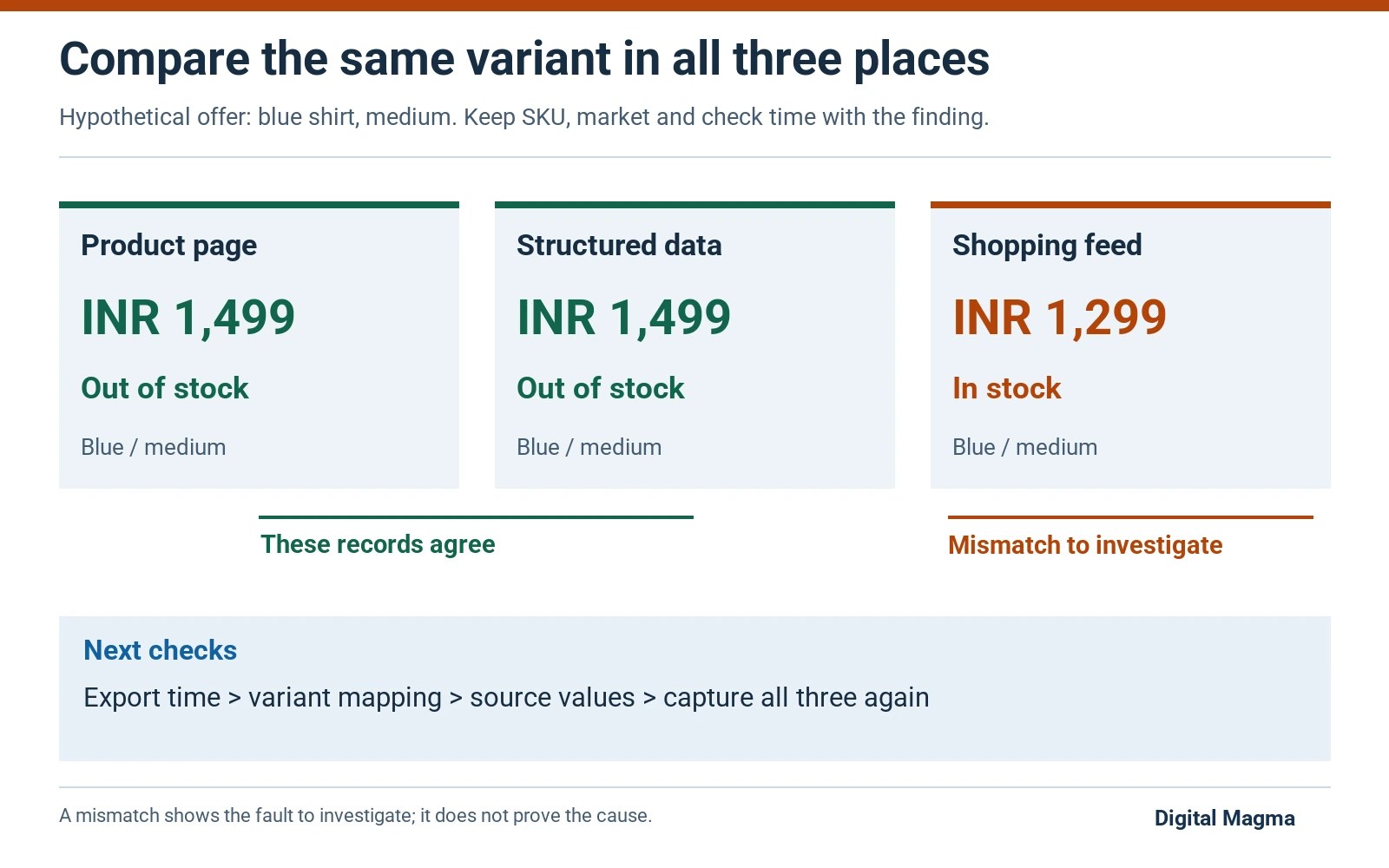
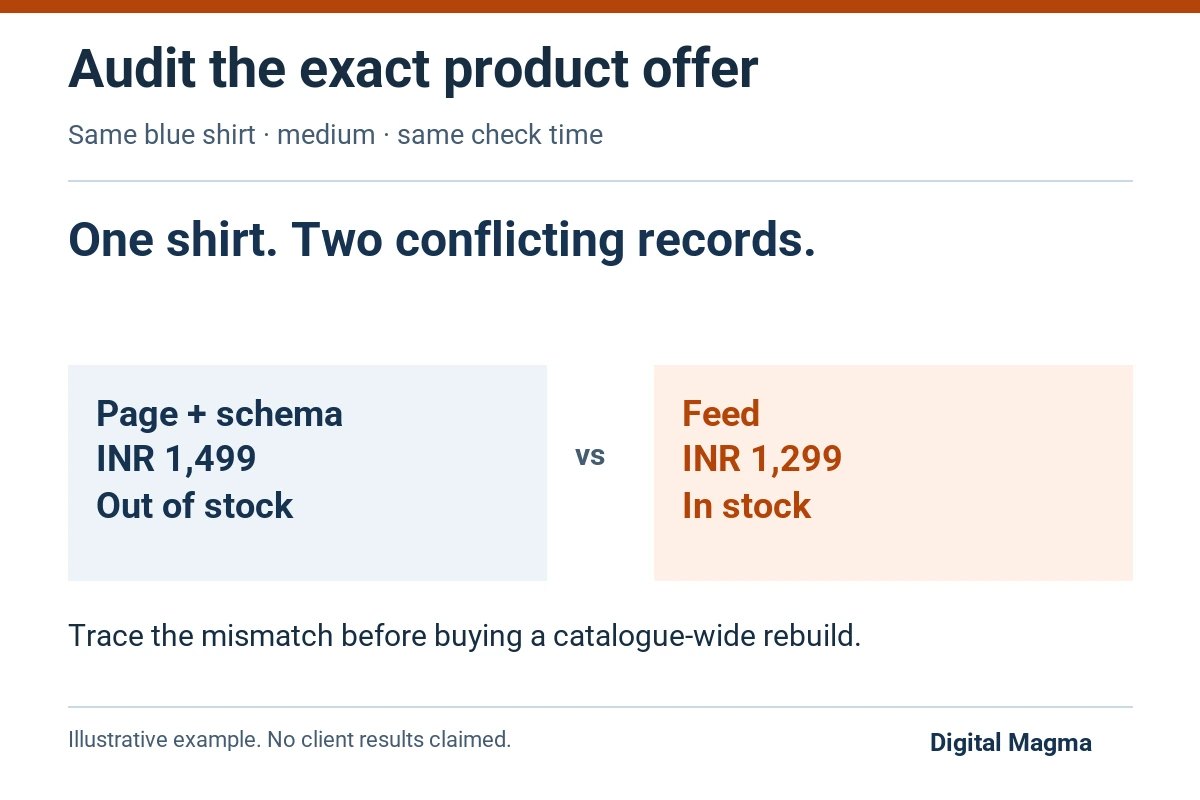
Same medium blue shirt: page and schema show INR 1499 and out of stock, while the feed shows INR 1299 and in stock.
Original Digital Magma diagram. Illustrative example. View full-size diagram.

An ecommerce AI search audit should check whether your product page, structured data and feeds describe the same product correctly. It should also test the buyer questions you agreed to investigate. You need a list of specific problems and fixes, with evidence for each one. Brand mentions alone cannot show whether a price or stock state is right.

Follow one product before auditing the whole catalogue

Suppose your blue shirt in medium costs ₹1,499 and is out of stock. The product page shows both correctly. Its structured data agrees. Your shopping feed still lists ₹1,299 and “in stock”.

Now the catalogue team has something to investigate. A report that says “your shop needs more AI visibility” leaves them guessing.

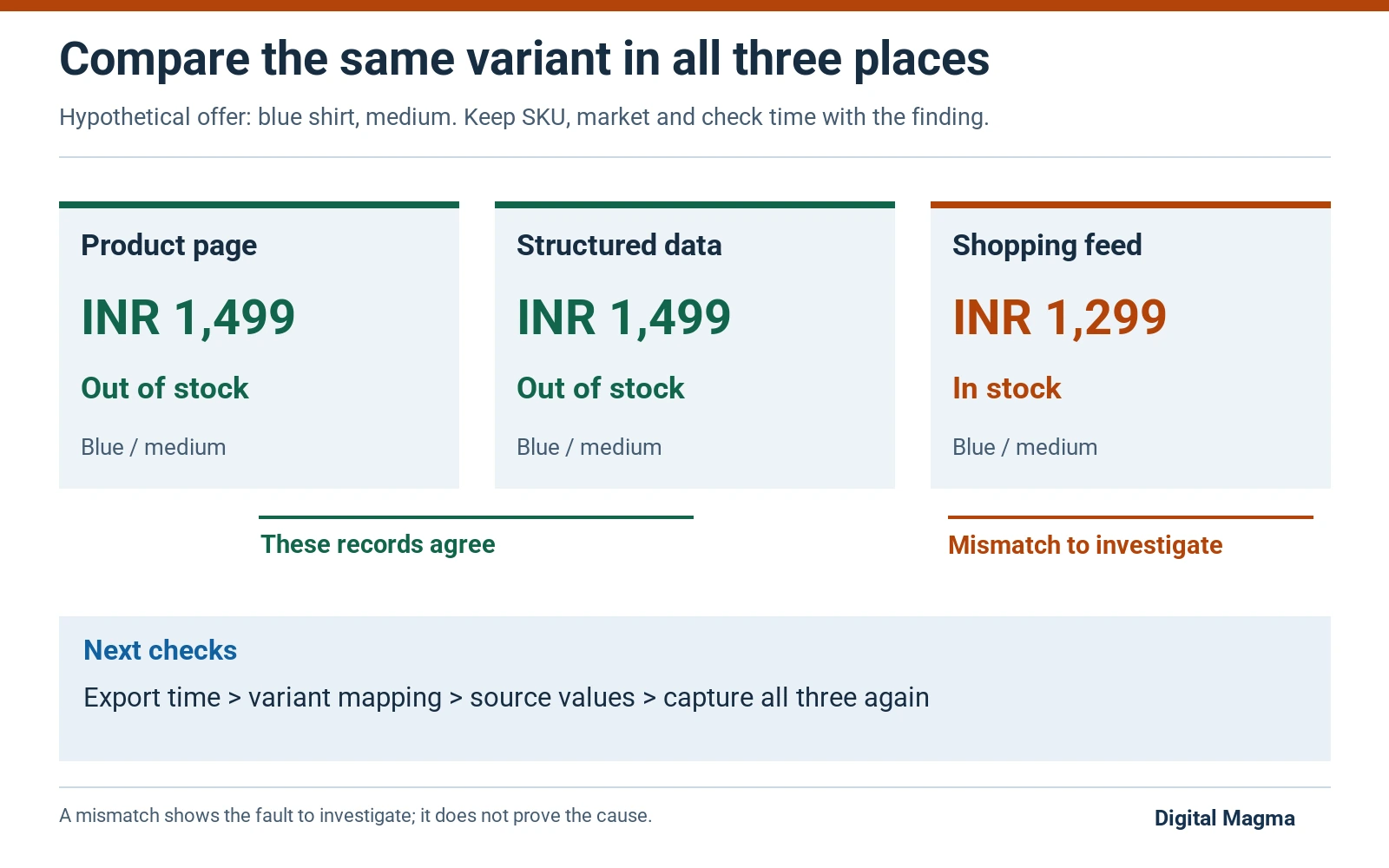
In this hypothetical example, the next job is to trace the feed’s price and stock values to their source. Check the export time first. Then check whether the feed uses the parent product while the page shows the selected size. Those are questions to investigate, not conclusions to put in a report without checking.

Start the sample with products that expose these differences: a variant, an unavailable item, a recently changed price or an unusual shipping condition. A homepage-only audit will miss most of them.

Keep the SKU, size, colour, destination market and check time beside each finding. “Wrong stock” becomes a useful task only when someone else can reproduce it.

Hypothetical medium blue shirt: product page and structured data agree, but shopping-feed price and stock disagree. Check export time, variant mapping and source values.
The same variant has two conflicting records. Investigate the source, fix it, then capture page, schema and feed again. Hypothetical example. View full-size example.

Do the page, schema and feed agree?

Compare the same offer. A medium blue shirt and a large blue shirt can have different prices or stock, so record the selected variant before comparing the page with its feed.

Google explains two routes for rich product data: product structured data and Merchant Center feeds. Providing both can broaden eligibility and help Google verify product information. That is Google’s guidance. Other assistants may use different sources.

Product-level reconciliation worksheet
FieldEvidence to compareOwner to identify
Price and currencySelected offer on page, markup and destination feedPricing or feed manager
AvailabilityVariant stock state and update timestampsInventory integration owner
IdentitySKU and applicable identifiers across recordsCatalogue team
VariantSize, colour and specific landing URLStore developer
Shipping and returnsVisible policy and supported structured fieldsOperations team

Do not “fix” the audit by changing only the markup while leaving the price a shopper actually sees unchanged. Find the source of the mismatch.

What does an out-of-stock recommendation prove?

It proves that the captured answer and the checked availability disagree. It does not by itself identify the source or age of the assistant’s information.

Here is a hypothetical test: a shopper asks for a blue shirt in medium, and an assistant recommends the product while that variation is unavailable. Save the question, complete answer, visible source links, selected variant and time. Then check whether the page, schema and feed all showed the current state.

If the page, markup or feed was wrong, fix that record first. If the data agreed, inspect the cited source and any platform-specific retrieval documentation before blaming the feed. The assistant may have used another page or older information.

An audit should state the limit of the finding. “This answer was stale in this test” is defensible. “Every AI platform ignores your stock feed” requires much broader evidence.

What should the technical access check cover?

Check the exact product URL as an anonymous visitor and save what the page returned.

  • A product URL that returns HTTP 200 and names the correct canonical.
  • Robots directives and any CDN or firewall challenge affecting the agreed crawler.
  • Product description, price and stock available in the delivered or rendered page.
  • Useful internal links from category and related product pages.
  • Structured data that agrees with the selected product.

A plugin setting is only a starting point. Open the product and compare what it shows with Google’s Merchant Center structured-data requirements, including the price and availability for the selected offer.

For an indexing exclusion, use the crawled currently not indexed guide before changing the whole catalogue.

How do you define acceptance before paying?

Another person on your team should be able to open the product, choose the recorded variant and see why the finding matters. If they cannot, the report needs more detail.

What a useful finding looks like

Product: blue shirt, medium, the recorded SKU and URL.
Observation: page and schema show ₹1,499 and unavailable. The feed shows ₹1,299 and available.
Next check: compare the export time and the variant-to-feed mapping.
After a fix: capture all three records again for that same variant.

This follows the hypothetical example above. The cause still needs checking. A stale export and a plugin bug are possible explanations, but this mismatch alone cannot tell you which one happened.

Give product accuracy to the person who owns the catalogue or operations policy. A marketer can improve a returns explanation, but should not invent the return window. Valid markup can describe an incorrect policy just as easily as correct one.

For a large catalogue, test the proposed rule on a normal product and an awkward variant before applying it everywhere. Keep the old mapping so your team can reverse an unintended change. Treat this pilot as part of the scope, with its own approval.

What belongs outside the first audit?

A new checkout integration, an inventory-system replacement and a broad content programme are separate projects unless the agreement explicitly includes them.

Ask for these costs to be itemised. You may only need to correct a feed mapping or a product template. Paying for a full rebuild before tracing the mismatch makes the decision harder to assess.

Likewise, a presence report cannot prove sales attribution. The audit can capture what an assistant said, what it cited and which factual errors appeared in the sample. Orders and qualified enquiries require their own measurement evidence.

Use this scope to compare suppliers on the same job. The lowest quote is less helpful when one proposal includes fixes and another ends at recommendations.

Buyer questions

Does Product schema guarantee AI recommendations?

Product markup describes your offer and can support eligible search appearances. It does not guarantee an AI recommendation, a citation or a sale.

Can the same audit cover every country?

Market differences can change currency, availability, shipping and the buyer question. Specify the markets in the scope and test the appropriate landing pages and feeds.

Should we share our entire customer database for this audit?

A public product-data audit usually starts with catalogue and page evidence. Ask why any non-public data is needed and agree a limited access scope before sharing it.

Sources and editorial method

Technical claims link to primary documentation in the relevant section. Buying worksheets are Digital Magma’s editorial recommendations. Examples are illustrative, not client results. This guide was prepared with AI assistance; no measured search volume or ranking outcome is asserted. Send corrections through our contact page.

About Ankit Sachan

Ankit Sachan is the founder and Head of SEO at Digital Magma, with 10+ years in search and digital marketing. Read his author profile and the agency approach.

Have a product-data mismatch to investigate?

Bring the product URL, selected variant and the records that disagree. We can discuss which part of the store or feed needs investigation.

Request an initial website review

Explore SEO services, compare SEO packages and read Google reviews.

Call +91 79823 19697 · Email us · WhatsApp

Related buying guides

Should you hire an AI SEO agency for B2B leads or fix SEO first?

Ready to hire an AI SEO agency for B2B leads? Digital Magma explains audit scope, proposal comparisons, proof and a practical first-project buying brief.

Digital Magma Blog

AI search

Should you hire an AI SEO agency for B2B leads or fix SEO first?

Before you buy another monthly package, find out whether you need better answers, a technical repair or help getting the work live.

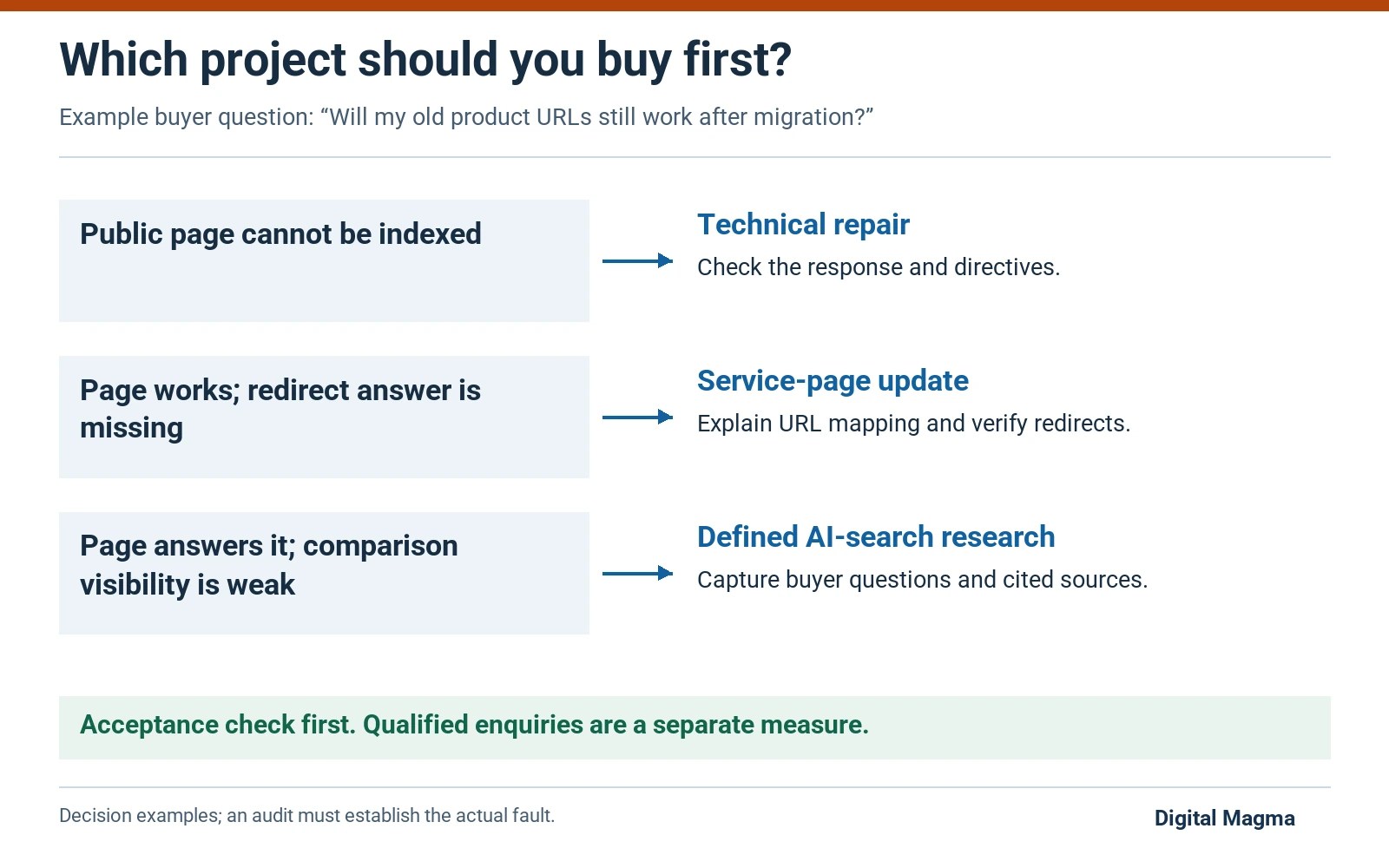
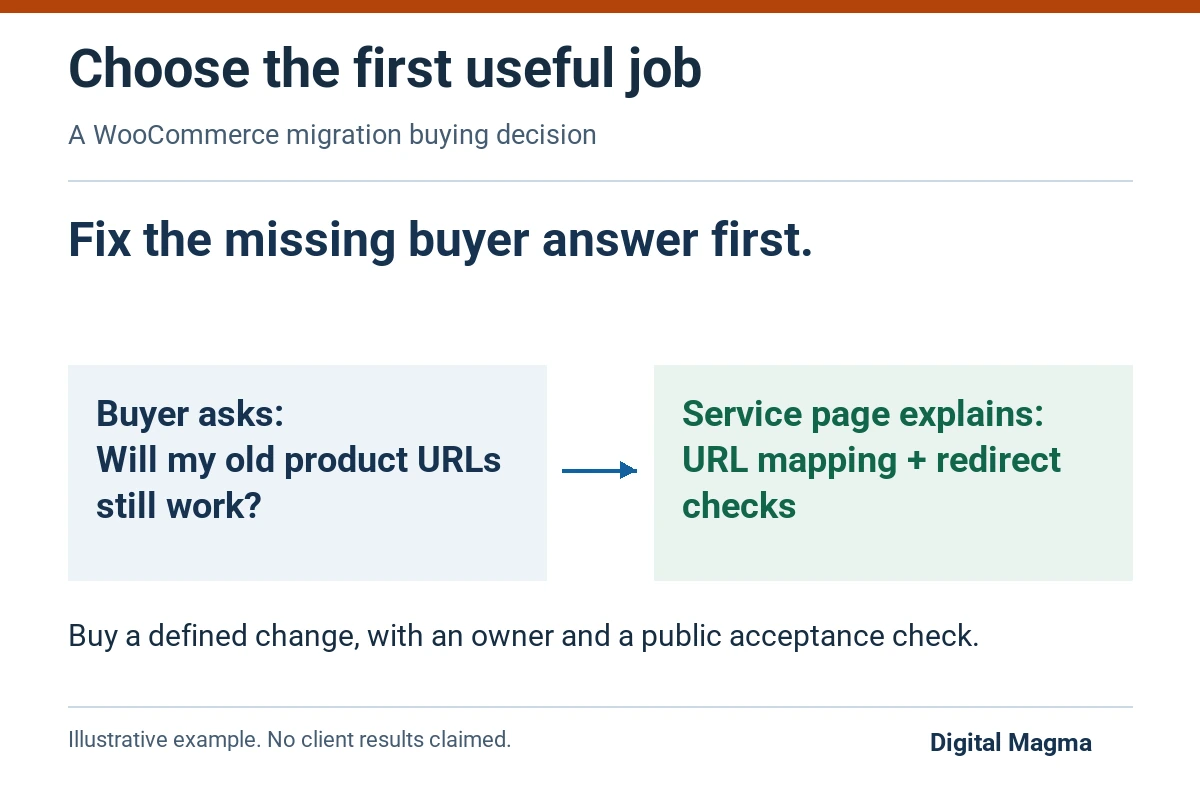
Buyer asks whether old product URLs will work after a WooCommerce migration; the service page explains URL mapping and redirect checks.
Original Digital Magma diagram. Illustrative example. View full-size diagram.

Hire an AI SEO agency when you know which buyers you want to reach and your team can publish the recommended changes. If the service page is unclear or the enquiry form fails, fix that first. Buy a defined audit and first improvement before committing to a monthly content package.

Start with the buyer who cannot find the answer

Imagine you run a software consultancy. One proposal offers twenty AI search articles a month. Another starts by fixing your migration service page. Which should you buy?

The article count cannot answer that. Your prospective customer might already have found the website and still be unable to tell whether you preserve product URLs during a WooCommerce migration. That missing answer belongs on the service page, where the customer is deciding whether to contact you.

Already have a clear service page, but never appear when buyers compare suppliers? Ask the agency to investigate those comparisons. Find out which questions buyers ask, which sources the answers cite and what those sources say about your service.

This is a buying example, not a client result. Its point is simple: the first proposal should explain the problem it will solve before it promises a volume of content.

A brief you can use in the first meeting

“We sell WooCommerce migration services to established shops. Buyers need to know how product URLs and redirects will be handled. Review our service page and show us the first change you would make, who will publish it and how we will check it.”

When does ordinary SEO work need to come first?

Start with access, clear service information and a working enquiry path. Adding another content programme to pages that cannot be fetched or understood gives you more work to diagnose.

Google’s AI search guidance says supporting links in AI Overviews and AI Mode require indexing and snippet eligibility. It does not prescribe special AI markup. That requirement applies to Google; ask for a separate explanation of any other platform in the proposal.

  • Can an anonymous visitor read the main service explanation without a login or button click?
  • Does the page describe who the service suits, what is included and how to ask for a quote?
  • Do enquiries reach the right person, with a record of their source where available?
  • Can someone approve and implement technical or content changes?

If these checks fail, commission the specific repair first. You can still plan AI research alongside it, but keep the responsibilities and budget visible.

How do you compare an AI SEO proposal with an SEO proposal?

Compare the work and the evidence, rather than the acronym in the heading.

Buyer comparison worksheet
QuestionUseful proposal detailFollow-up if missing
Which buyer questions?A named query set with audience and locationAsk which commercial decisions each question represents
Which pages change?Specific URLs and the intended improvementAsk for an example before approving a large content batch
Who implements?Agency or client owner for each taskSeparate recommendations from deployment
What proves delivery?Change log, public checks and source capturesRequest an acceptance test for each deliverable
How is impact measured?Visibility evidence and qualified enquiries reported separatelyAsk how attribution gaps will be disclosed

A supplier can legitimately offer research without implementation. The problem is paying for implementation while receiving a spreadsheet that your team has no time to act on.

What should the first paid project include?

The first project should tell your team what to change and why. A long report that leaves every task waiting for someone else is a poor starting point for a small team.

Agree which buyer questions will be tested and which pages will be reviewed. For each proposed change, the agency should explain the finding, the person who will fix it and the check that confirms it reached the website.

Then settle the practical details. Will the agency publish the copy, or send a document? Does the quote include a developer? Who pays for research tools? Your answers can change the cost and usefulness of the same recommendation.

A manageable first deliverable

One service page, one missing buyer answer, one named person to approve the facts and one public check after publication. Agree the research and writing scope before adding a monthly article target.

This is our suggested starting scope, not a universal package. A larger team with its own developers may need research alone. A founder without development support may need the agency to carry the change through to publication.

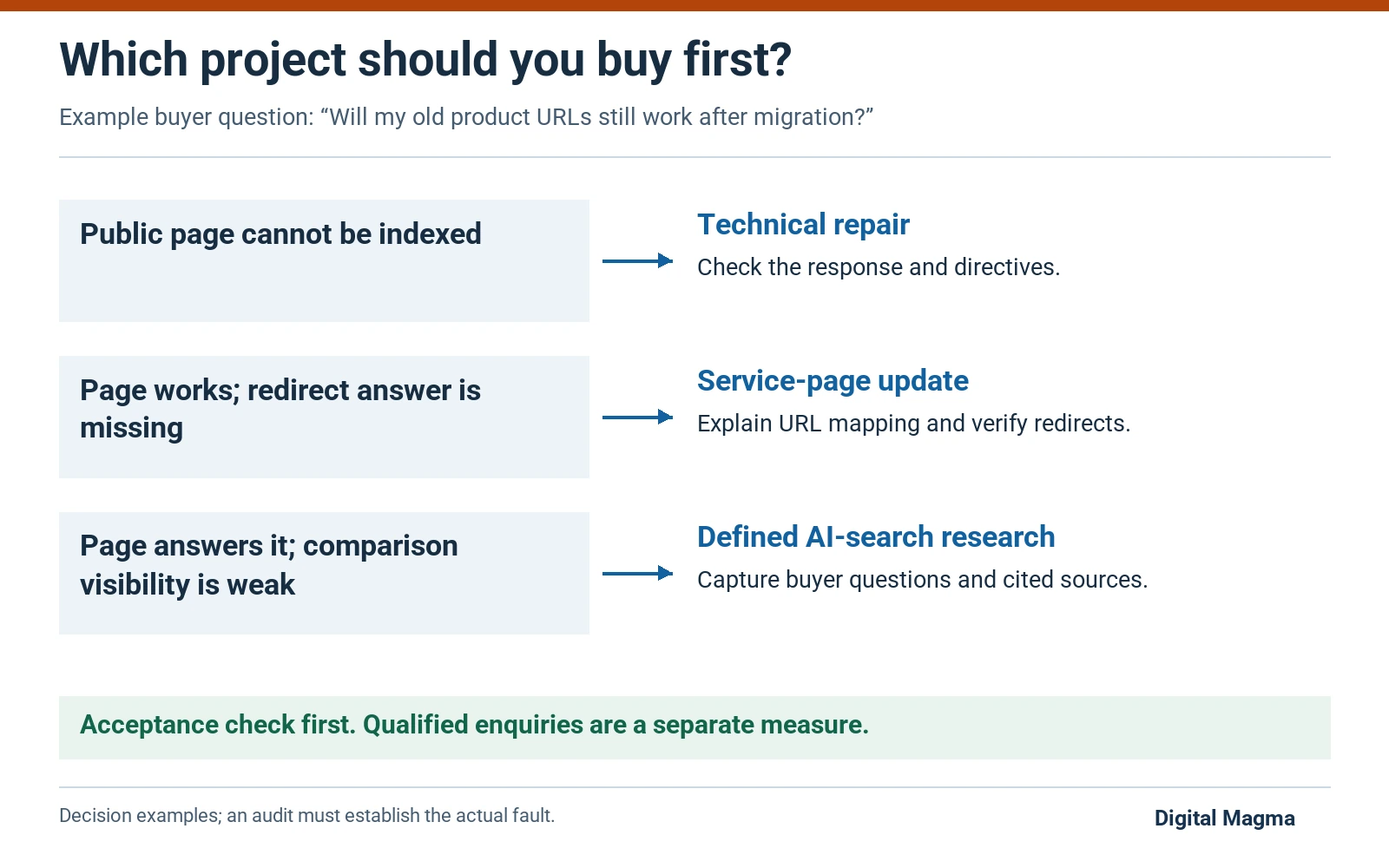
Choose technical repair, service-page clarification or AI-search research from the observed finding.
Match the project to the finding, then assign a public acceptance check. These are illustrative decisions, not client results. View full-size example.

Which evidence should you ask to see?

Ask for evidence that resembles your situation. A screenshot of a brand mention does not establish that a provider can improve your lead quality.

Look at an audit finding beside the change it led to. Then see how the agency checked that change. Private client information may need redaction. A supplier can explain the method without exposing confidential records.

Keep measured outcomes separate from examples. If an agency shows an illustrative report, it should be labelled. If it cites a traffic gain, ask about the date range, starting point, affected pages and other changes that happened during the period.

Use our AI SEO reporting buying guide to define what a mention, citation, visit and enquiry mean before they appear in a contract.

What can make a sensible proposal a poor fit?

A good plan can still be too much for your team to carry out.

A founder-led business with no developer may need implementation support more than another audit. A larger B2B team may have writers already and need help deciding which buyer questions to investigate. Buy the help your team is missing.

Pause if the proposal promises permanent placement, offers no account access, or cannot identify the pages it will change. Also pause if the agency asks you to publish claims your team cannot support. Your website carries those assertions after the engagement ends.

In the buying meeting, ask: “What would you advise us to postpone?” A useful answer shows that the supplier can prioritise within a real budget.

Buyer questions

Can AI SEO replace our existing SEO agency?

It depends on the work your current agency handles. Compare research, technical implementation, content ownership and measurement. Avoid paying two teams to rewrite the same pages without a shared plan.

Should we buy a monthly package immediately?

Start with a defined problem and a clear scope. A recurring package makes sense when the baseline and execution needs are understood, and your team can review the ongoing work.

Is llms.txt enough to make a business appear in AI answers?

A file alone does not establish visibility or citations. Ask which platform the agency is discussing and what actual access, content and answer evidence supports its recommendation.

Sources and editorial method

Technical claims link to primary documentation in the relevant section. Buying worksheets are Digital Magma’s editorial recommendations. Examples are illustrative, not client results. This guide was prepared with AI assistance; no measured search volume or ranking outcome is asserted. Send corrections through our contact page.

About Ankit Sachan

Ankit Sachan is the founder and Head of SEO at Digital Magma, with 10+ years in search and digital marketing. Read his author profile and the agency approach.

Want a first project you can evaluate?

Bring one service page and the proposal you are comparing. We can discuss the missing answer, the implementation work and a sensible first scope.

Request an initial website review

Explore AI SEO services, compare SEO packages and read Google reviews.
Call +91 79823 19697 · Email us · WhatsApp

Related buying guides

Crawled currently not indexed? Start with these checks

Compare Search Console statuses, inspect canonical signals and use a practical worksheet to investigate pages outside the Google index.

Digital Magma Blog

Technical SEO

Crawled currently not indexed? Start with these checks

Google has crawled your page but has not added it to its index. Before rewriting it, check the recorded crawl date, the canonical URL and what Google actually fetched.

Diagram: crawled pages are not automatically indexed; indexed pages are not guaranteed search visibility.
Original AI-created infographic: crawling, indexing and search visibility are separate steps.

Crawled currently not indexed: what does it mean?

Crawled currently not indexed means Google visited the URL but has not added it to its search index. Start with the indexed result in URL Inspection: check when Google last crawled the page and which canonical it selected. A green live test checks access today. It cannot tell you whether Google will index the page.

First, decide whether you want this URL in search. Your main service page probably belongs there. A shopping basket or a filter URL that repeats another product listing may not. Fixing the latter just to increase your indexed-page count can send you in the wrong direction.

Google’s Page indexing report says the status can change and there is no need to resubmit an unchanged URL.

The label does not tell you what caused the exclusion. If someone recommends a rewrite immediately, put the page and its inspection result in front of them first. What, exactly, needs fixing?

Which indexing status are you actually seeing?

Read the full status label first. A URL Google has discovered needs a different investigation from one it has already fetched.

Search Console labels and the next useful check
StatusMeaningNext check
Crawled currently not indexedFetched, currently outside the index.Indexed inspection, crawl date, rendered content.
Discovered currently not indexedKnown URL, not yet crawled.Discovery links and server availability.
Alternate page with proper canonicalAn alternate points to an indexed canonical.Confirm the preferred URL is correct.
Google chose a different canonicalGoogle selected another version.Compare both URLs and their signals.
Excluded by noindexA directive excludes indexing.Decide whether the directive is intentional.
Soft 404The page appears missing or empty despite its response.Inspect the actual content and response.

Use the label shown for your exact URL. Similar-looking labels can point to very different next steps.

Why does the live test pass while the page stays unindexed?

The live test checks what Google can fetch now. The indexed result describes the version recorded in Google’s systems. Start with that recorded result.

Copy the exact URL into Google Search Console. Record the indexed result before running a live test. Then note the last crawl date and the Google-selected canonical where it is available. Save both screenshots.

A passing live test is useful: it rules out some current access problems. But it does not run all the checks Google uses to select pages for its index, including duplicate and canonical evaluation. That is why the green result and the indexing exclusion can both be correct.

Check the dates. If Google last crawled the URL before your rewrite, the inspection may still describe the older page.

Google explains these limitations in its URL Inspection documentation. For a single URL, read its inspection details alongside the broader report. Their dates and scope differ.

Is Google choosing another URL as the canonical?

When several URLs contain similar material, Google may choose one to represent them in search. Confirm which one you intended to keep.

Look at the HTML canonical, redirects and internal links together. If a product exists at both a clean address and a tracking-parameter address, link to the version you want indexed. Keep that choice consistent in your sitemap.

Compare the Google-selected canonical with the address you want visitors to find. If they differ, inspect both pages before changing the annotation.

For example, if a tracking URL repeats the clean product page, make your canonical, internal links and sitemap agree on the clean address. If the two pages serve different needs, compare their content before treating them as duplicates.

Do not replace every canonical with the homepage URL. That can confuse the relationship between unrelated pages. Google’s canonical documentation covers redirects, HTML annotations, sitemaps and inconsistent signals.

What should you check on a WordPress page?

Check the page while logged out. Your administrator view can hide a problem that visitors and crawlers still encounter.

Open the published URL in a private browser window. Does it show the full article? Then check the document response, canonical and robots directives. A correct setting in your SEO plugin helps only if the public page delivers it.

  • Confirm the production site is not carrying a staging noindex directive.
  • Check the SEO plugin’s setting for this post and its content type.
  • Inspect the visible content after your page cache and CDN refresh.
  • Check that a security plugin is not returning a challenge or empty response.
  • Follow the published navigation and content links to the page.
  • Verify the primary copy is available in rendered HTML.

A saved change does not always reach the public page immediately. If your editor shows the new version while an anonymous visitor sees the old one, inspect the page cache and CDN response. Another rewrite will leave that delivery problem unresolved.

For JavaScript-heavy pages, inspect the rendered version as well as the initial response. A working interface can conceal missing text from a crawler. Google’s JavaScript SEO guide explains how crawling, rendering and indexing fit together.

Does this page answer anything your other pages miss?

Put this page beside the other article on your site that answers the same question. Can you explain why a visitor needs both?

A city-name swap rarely answers that question. Neither does another 500 words of background. Look for the missing detail: a local constraint, a worked example or the step someone keeps getting wrong.

Add something the reader can use: an observed error, a worked example, a dated source or a decision the existing explanation leaves unresolved. Extra length alone supplies none of those.

Suppose two guides explain exactly how to submit a sitemap. Keep the stronger guide, merge any useful missing details and plan an appropriate redirect if you retire the redundant URL. If they solve separate problems, make the distinction visible in the title, opening answer and internal links.

Keep useful old material. Before consolidating anything, export the content and check its existing traffic, links and business role.

What evidence should you record before choosing a fix?

Write down the observation before deciding what it means. “Google last crawled the old version” is evidence. “The new page is too short” is a guess until you investigate.

Start with the URLs that matter to your business. The hypothetical worksheet below shows how one observation can lead to a specific check. It is not a client recovery report.

Hypothetical diagnostic worksheet
ObservationInterpretationAction to test
Last crawl predates a rewriteThe stored version may be olderCompare old and new output, then monitor recrawl
Canonical points to another productThe preferred URL needs reviewCorrect the unintended signal and related links
Article appears only after a clickPrimary content may be harder to processMake the main explanation available on load
Two pages answer the same query identicallyThey may be redundantChoose a distinct role or plan consolidation
URL has no content links from relevant pagesDiscovery and context can be improvedAdd useful descriptive links from related guides

Keep one row per URL. Record the crawl date, canonical, response status and robots directives, then add what you changed and when. When Google crawls again, you can compare the new result with that record instead of trying to remember what was live last week.

How do you save a useful record of the problem?

Save the document response before changing a setting. A screenshot of the status alone leaves your developer with very little to investigate.

In your browser’s developer tools, open Network and reload the page. Select the main document request rather than an image or stylesheet. Save its final URL, status and response time, along with the date and timezone of your check. Remove cookies and authorization headers before sharing an export.

If present, save the Cache-Control, Age, Content-Type and X-Robots-Tag headers. They can help your developer investigate caching or an indexing directive. To check whether an update reached the public page, compare its canonical and opening paragraph with the copy saved in WordPress.

If your developers use command-line checks, ask them to preserve the redirect chain, HTTP status and response body as separate artifacts. A header-only request cannot tell you whether the article renders correctly. Keep credentials out of screenshots, shared HAR exports and public issue reports.

Link the saved response to the URL’s worksheet row. If a firewall challenge disappears before your developer opens the page, that capture may be the only record of what you saw.

What did our own website check establish?

Our breadcrumb update exposed a useful limit of public website checks: a working page tells you little about whether Google has selected it for search.

On 4 October 2026, Digital Magma checked 145 sitemap-linked URLs, including the homepage, during its breadcrumb update. All returned HTTP 200, and every non-home URL contained BreadcrumbList markup. This was a public HTTP audit, not a fresh Search Console indexing export.

So we could confirm the responses and markup. We could not use that result to claim 145 indexed pages. That would require current Search Console evidence.

When should you request another crawl?

Request a crawl after publishing a new page or making a meaningful correction. The request tells Google there is something to fetch, without deciding whether it belongs in the index.

Once the page is accessible and the change is worth recrawling, use URL Inspection for an individual address. Use an updated sitemap to communicate a collection of new or revised URLs. Keep modification dates truthful.

Keep a dated record of the change. Google’s recrawl guidance says crawling can take days to weeks and repeated requests do not speed it up. There is no acceptance deadline.

When the next crawl appears, compare its date with your update. If it happened earlier, give Google time to fetch the revised page before judging the result.

Crawled currently not indexed: common questions

These answers address the decisions that usually come up after the first inspection.

Does this status mean Google penalised my site?

The status does not by itself diagnose a penalty. Check Search Console’s Manual Actions and Security Issues reports separately, then investigate the URL’s indexed inspection details.

Will a longer article fix it?

Extra length alone does not establish usefulness. Add information that helps the visitor complete the task, remove redundant copy and compare the page with competing or overlapping content.

Why is the live test green when the page is not indexed?

The live test can fetch and process the page now. It does not perform every indexing check, including duplicate and canonical evaluation. Check the indexed inspection result separately.

Should every filter URL be indexed?

Index only the useful search destinations you intend to maintain. A parameter combination with no distinct value may belong outside the index. Review canonical and crawling behaviour before changing large URL sets.

Can structured data force indexing?

Structured data describes eligible content. It does not override Google’s index selection or guarantee a rich result, ranking or AI citation.

Sources, author and how this guide was prepared

This guide uses Google’s documentation and the dated public-site check described above.

Research also reviewed public Reddit questions about conflicting reports and ecommerce parameters. Community explanations were treated as questions to verify, not technical authority. English, Russian and Chinese versions of Google’s recrawl guidance were cross-checked. No third-party article was translated into this post.

AI tools assisted the research and drafting. The technical references are linked above, the worksheet is hypothetical, and our site observation covers only the public checks described in that section. Found an error? Send it through our contact page.

About Ankit Sachan

Ankit Sachan is the founder and Head of SEO at Digital Magma, with 10+ years in search and digital marketing. His background includes technical SEO and international campaigns. Read his author profile and the agency approach.

Need help deciding what to change?

Digital Magma can review crawled currently not indexed URLs alongside your Search Console evidence and public-page responses.

Bring the affected addresses and their inspection details. Start with a free initial website review, see our SEO services or compare published SEO packages. Read Google reviews before choosing a provider.

Call +91 79823 19697, email contact@digitalmagma.com or message on WhatsApp. Digital Magma will explain the indexing evidence and the proposed work. No fixed indexing date or ranking is promised.