
Google Ads
Google Ads lead quality audit: what should you check before increasing budget?
More forms do not necessarily mean more customers. Compare what each campaign spends to produce an enquiry your sales team can actually use.
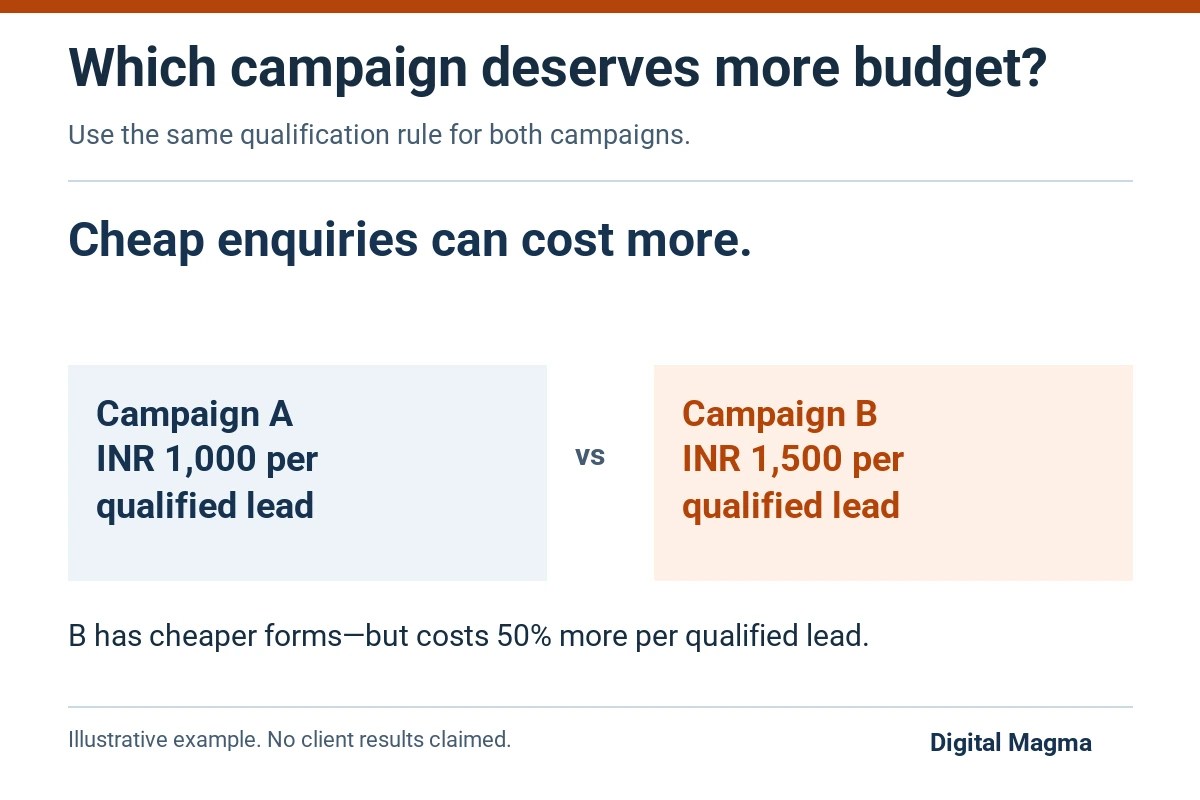
Before increasing Google Ads spend, check whether the leads qualify, which actions guide bidding and whether enquiries reach the sales team. Compare cost per qualified lead alongside cost per form submission. More cheap submissions can still leave you paying more for each useful opportunity.
The cheaper form submission can cost you more
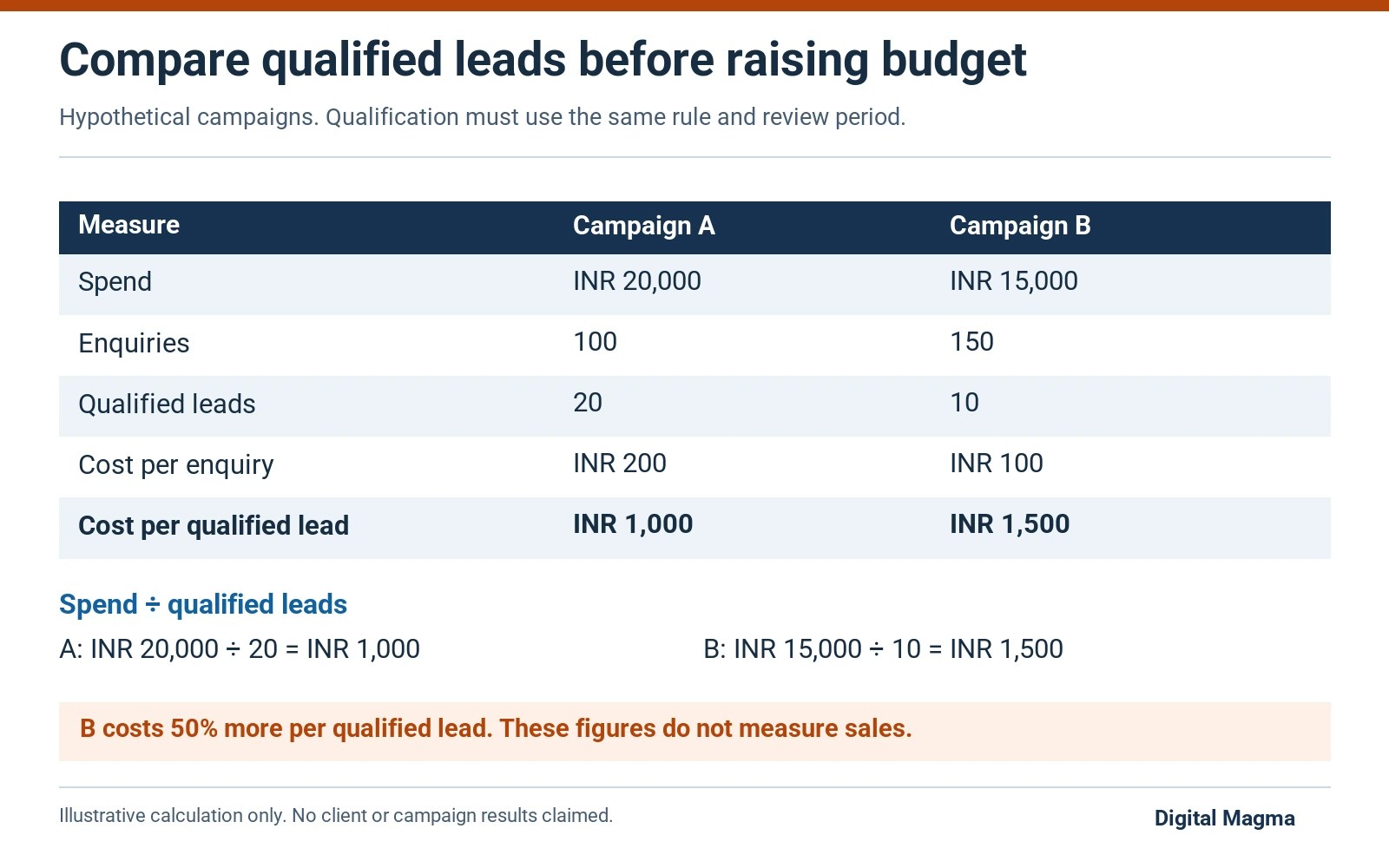
Suppose Campaign A spends ₹20,000 and brings in 100 enquiries. Twenty meet your sales team’s qualification rules. Campaign B spends ₹15,000 and brings in 150 enquiries, but only ten qualify.
Campaign B looks cheaper in a basic lead report: ₹100 per enquiry versus ₹200. Once you compare qualified leads, the result reverses.
| Measure | Campaign A | Campaign B |
|---|---|---|
| Spend | ₹20,000 | ₹15,000 |
| Enquiries | 100 | 150 |
| Qualified leads | 20 | 10 |
| Cost per enquiry | ₹200 | ₹100 |
| Cost per qualified lead | ₹1,000 | ₹1,500 |
Divide spend by qualified leads: ₹15,000 ÷ 10 = ₹1,500. In this example, B costs 50% more per qualified lead even though its form submissions cost half as much.
This is a calculation, not a campaign result or a promise of improvement. It also does not tell you which campaign produces more sales. That needs a later sales outcome and a consistent way to record it.
Before increasing the budget, find out whether your report can make this comparison at all. If the sales team cannot connect its enquiries to the campaigns, start there.
Which actions are used as bidding goals?
Ask the agency to show the conversion actions and the goals actually applied to the campaign.
Google distinguishes primary and secondary conversion actions. Their role depends on how goals are configured, including custom-goal exceptions. Do not assume that a phone-button click and a qualified opportunity should be rewarded in the same way.
Request a list of action names, sources, counting settings, intended business meaning and campaign usage. Check for duplicate tracking as well as missing tracking. A form event firing twice can distort a result even when every visitor is real.
The useful question is: “What does this account treat as success?” A screenshot of a falling cost per conversion does not answer it.
How do you trace an enquiry through to a sale?
Pick a small sample of recent enquiries you are authorised to inspect. Follow each one from the form or call record into the sales system. Can you find the campaign, the qualification decision and what happened next?
Agree the qualification rule before counting. For a local service business, an illustrative rule might be: needs a service you sell, is in an area you serve and has provided enough contact information for a follow-up. Your sales team must decide its own rule and use it consistently across campaigns.
A duplicate submission should not become two opportunities. A person asking for a job should not be counted as a prospective customer simply because they completed the same form. Keep these reasons in the sales record so the marketing team can see the pattern.
Google’s enhanced conversions for leads guidance explains how first-party outcome information can support measurement. Any integration needs an account-specific review and appropriate data handling.
Test a record arriving once with the intended status. Then establish who handles duplicates and later status changes. A “CRM connected” badge does not answer either question. Keep personal lead details out of public reports.
What can you learn from the search and landing-page evidence?
Look for a mismatch between the buyer’s question and the offer they reach.
A company selling ongoing maintenance may receive requests for a free tutorial if its ads and landing page never make the commercial scope clear. The right correction may be wording and query targeting, rather than a larger daily budget.
| Finding | Question to investigate | Possible test |
|---|---|---|
| Many requests for an unoffered service | Does targeting or page wording suggest it? | Clarify the offer and review relevant query evidence |
| Enquiries from unsupported areas | Do location settings and eligibility wording agree? | Review targeting and show supported areas clearly |
| Qualified leads never receive a reply | Does the delivery and follow-up process work? | Test routing and record response ownership |
| Conversions exceed recorded submissions | Are actions duplicated or counting other events? | Reconcile events with the form records |
A test is a hypothesis, not a promised improvement. Record what changed so you can interpret the next period without mixing several explanations together.
When is more budget a reasonable next step?
Consider increasing spend after the useful outcome is measured and your team can handle more of those enquiries.
Check what a qualified enquiry costs, whether sales can respond and how much data you have. A tiny number of sales cannot justify a confident forecast. Equally, a healthy campaign may be constrained by a slow response process rather than lack of demand.
Use a planning calculation with your own inputs: advertising cost divided by attributed qualified opportunities gives a cost per qualified opportunity for that defined period. It does not prove incremental sales or future performance.
Ask the agency what would invalidate its recommendation. A defensible budget proposal should explain the evidence, assumptions and review point, rather than making a revenue promise from clicks alone.
What should a paid lead-quality audit deliver?
The audit should explain what is wrong, what to change and who will make the change.
- An agreed qualification definition and a reconciliation sample.
- A conversion-action and campaign-goal review.
- Specific query, offer and landing-page findings.
- Implementation tasks with owners and acceptance checks.
- A reporting plan that separates submissions, qualified leads and sales.
Clarify whether implementation is included. Ask how sales feedback will reach the person managing the campaign, and whether your team can access the resulting records after the engagement ends.
If the enquiry form or page needs rebuilding, coordinate the audit with a website project scope review. Advertising and website work should use the same definition of a completed enquiry.
Buyer questions
Should we stop all campaigns while investigating?
The evidence should guide that choice. A broken form or misleading offer may justify urgent action; a reporting discrepancy may need a narrower correction. Assess the affected campaigns and business impact.
Is lower cost per lead always better?
Compare the quality definition and later outcomes. A cheaper submission can be less useful if it rarely becomes a relevant opportunity.
Does a conversion integration guarantee better sales?
An integration cannot guarantee sales. It can improve the available measurement signal, but offer quality, demand, qualification and follow-up still affect sales. Test the implementation and evaluate outcomes separately.
Sources and editorial method
Technical claims link to primary documentation in the relevant section. Buying worksheets are Digital Magma’s editorial recommendations. Examples are illustrative, not client results. This guide was prepared with AI assistance; no measured search volume or ranking outcome is asserted. Send corrections through our contact page.
Getting enquiries that rarely qualify?
Bring your campaign totals and the sales team’s qualification rules. We can discuss where the enquiry path needs investigation before more budget goes in.
Request an initial website review
Explore PPC services, compare SEO packages and read Google reviews.