AI search glossary
What Is Semantic Search, and How Do Entities and Vectors Power It?
If search engines understand meaning, do keyword variants still matter? This entry explains semantic search in plain words, compares it with keyword, vector and hybrid search, and quotes what Google itself says about synonyms.
What is semantic search? The short answer
Semantic search finds results by meaning and intent rather than by matching the exact words typed. It uses context, known entities and, in many systems, vector embeddings that place similar ideas close together. So a query can match a page that answers it in different words, which keyword-only search would miss.
Key takeaways
- Keyword search matches words. Semantic search matches meaning.
- Embeddings turn text into numbers, so closeness in meaning becomes closeness in a vector space.
- Google Cloud says Google Search added semantic search in 2015 with RankBrain, alongside keyword search.
- Google says its AI systems understand synonyms, so you need not chase every long-tail variant.
- Exact codes, SKUs and new names still need keyword matching. That is why hybrid search exists.

Semantic search: how intent, entities and context work
Semantic search works by interpreting three things about a query: the intent behind it, the entities it mentions, and the context around it. Together they let an engine decide what the person wants, even when the words are vague, misspelt or different from those on the best page.
Intent. “Best welding machine for aluminium” wants a comparison. “Welding machine price” wants numbers. The words overlap, but the needs differ.
Entities. Google’s 2012 Knowledge Graph launch was framed as “things, not strings”. Recognising a brand, city or product as a thing removes ambiguity.
Context. Location, earlier queries in a conversation and the wording around a term all change its likely meaning.
Google’s ranking systems guide names two systems behind this. BERT helps Google understand “how combinations of words express different meanings and intent”.
Neural matching, the same guide says, helps it “understand representations of concepts in queries and pages and match them to one another”.
Semantic search building blocks: embeddings and vector search in plain words
Semantic search in most modern systems runs on embeddings. An embedding model turns a piece of text into a list of numbers, a position on a map of meaning. Texts about similar things land near each other, so finding relevant content becomes a matter of finding nearby points.
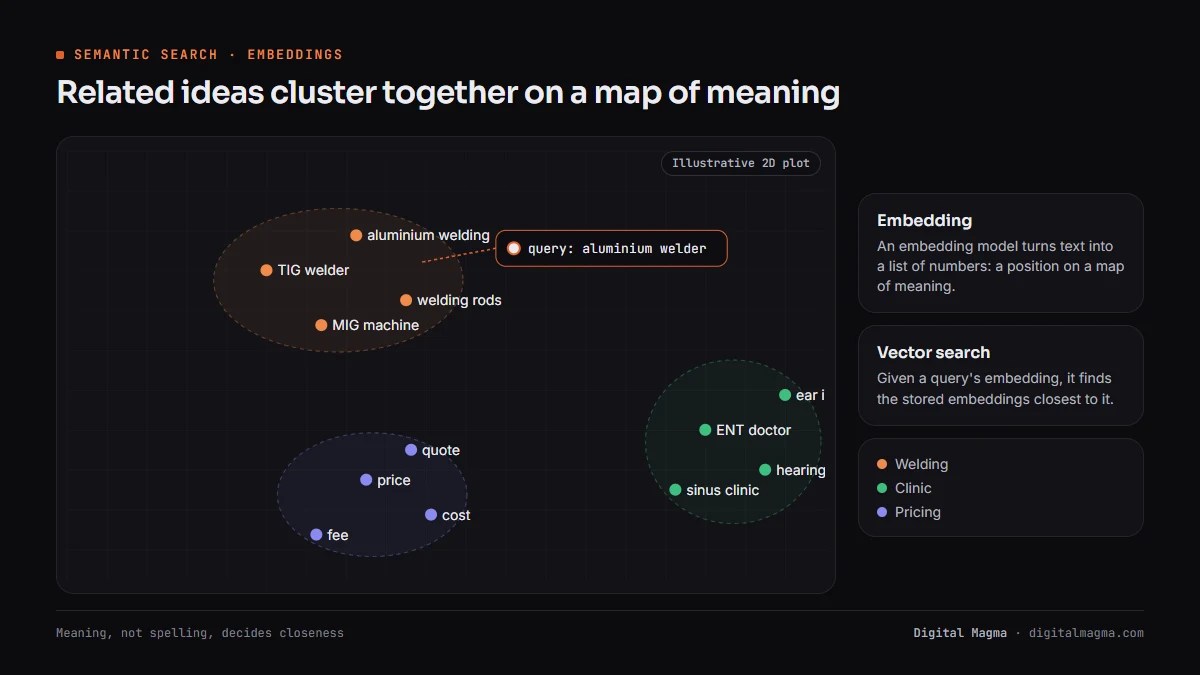
Google Cloud’s hybrid search documentation describes it this way. Embedding models “build a vector space as a map of content meanings”.
Vector search is the lookup step. Given a query’s embedding, it finds the stored embeddings closest to it.
Google’s machine learning crash course adds the technical reason. Embeddings are lower-dimensional representations that capture meaningful relations words alone do not.
You do not need the maths to write well for it. You only need to know that meaning, not spelling, decides closeness.
One practical consequence follows. Two paragraphs that say the same thing in different words end up near each other, so repeating an idea with new phrasing adds little for a vector system.
Digital Magma uses that point when editing drafts. Repeated ideas get cut, and the space goes to a new fact, a new example or a question the page has not yet answered.
Semantic search vs keyword search vs vector search vs hybrid search
Semantic search is the goal, and keyword, vector and hybrid search are ways of reaching it or falling short of it. Keyword search matches tokens. Vector search compares embeddings. Hybrid search runs both and merges the results, covering each method’s blind spots.
| Approach | Matches on | Strong at | Weak at |
|---|---|---|---|
| Keyword (token-based) | Exact words and tokens | Codes, SKUs, names | Synonyms and paraphrase |
| Vector | Embedding closeness | Paraphrase, related ideas | Words the model never learned |
| Semantic | Meaning, using intent, entities and often vectors | Vague or conversational queries | Depends on the method underneath |
| Hybrid | Keyword and vector together | Both kinds of query | More complex to build |
Google Cloud gives the key limit. Semantic search “can only find data that the embedding model can make sense of”.
Product numbers, brand-new names and internal codenames fall outside it. Google Cloud calls that “out of domain” data, which keyword search still catches.
Semantic search in Google and AI search
Semantic search has been part of Google for years, and Google’s AI features build on it. Google Cloud’s documentation calls Google Search one of the most popular hybrid systems, saying it added semantic search in 2015 with RankBrain while keeping keyword search. AI Overviews and AI Mode sit on the same ranking systems.
Google’s guide to generative AI features speaks directly to writers. AI systems “can understand synonyms and general meanings of what someone is seeking”.
It goes on: “you don’t have to worry” about lacking long-tail keywords or every variation of how people search.
The same guide warns against the opposite habit. Making separate pages for each query variation, mainly to manipulate results, breaches the scaled content abuse policy.
AI answers also use query fan-out, which Google defines as concurrent related queries generated to fetch more results. One question becomes several searches.
Digital Magma’s query fan-out entry explains why a page that covers related questions can be retrieved for more of them.
Semantic search for a business’s content: why it matters
Semantic search changes how a business should plan content. Instead of one page per keyword variant, it rewards one strong page per topic that answers the real question fully and names the things involved clearly. That means fewer, deeper pages, and less time spent on near-duplicate wording.
It also lowers the cost of plain language. Buyers rarely use industry jargon, and a page written clearly can still match their words.
Internal search benefits too. A site search or support chatbot built on embeddings can find the right help article when a customer describes a problem in their own terms.
Digital Magma plans knowledge-base pages around topics, not variants. This page covers semantic search once, rather than splitting “semantic search meaning” and “semantic search definition” into separate URLs.
Keywords still matter for exact things. Product codes, model numbers, brand names and place names should appear exactly as people type them.
For AI tools that retrieve passages, see our entry on retrieval-augmented generation.
Semantic search: how to write for it (5 steps)
Semantic search rewards writing that makes meaning easy to extract. These five steps follow Google’s guidance on helpful content and generative AI features. Digital Magma uses them on every page it plans, including this one, and none requires special tools or new markup.
- Start from the question. Write the answer in the first paragraph, in plain words.
- Name the entities. Say which product, place, standard or company you mean, exactly.
- Cover the related questions. Answer what a reader would ask next, on the same page.
- Keep exact terms exact. Codes, model numbers and proper names stay as people type them.
- Structure for scanning. Clear headings and short paragraphs help readers. Google says it needs no special “chunking”.
Step five deserves care. Google’s guide says there is “no requirement” to break content into tiny pieces for AI.
Write for the reader first. Meaning that is clear to a person is usually clear to a model.
Semantic search in our client work
Semantic search explains a pattern in Digital Magma’s client work. A Canadian welding equipment manufacturer, with us for three years, holds 40+ keywords in Google’s top 10 and appears in AI Overviews and ChatGPT. Its pages answer engineers’ questions in full.
Its product pages keep model names and specifications exact. That covers the keyword side that semantic matching misses.
For a Toronto ENT clinic, patients describe symptoms in everyday words. Service pages written in that language match how people actually ask.
For an app development company selling in six countries, each market page names its country and uses local terms naturally.
Semantic search: frequently asked questions
Semantic search questions from content marketers and SEO teams.
What is semantic search in simple words?
Search that works out what you mean from the words you type, plus context. It can match a page that answers your question in different words.
What is the difference between semantic search and vector search?
Semantic search is the goal of matching by meaning. Vector search is one technique for it, comparing embeddings to find content with similar meaning.
What is the difference between semantic search and keyword search?
Keyword search matches exact tokens. Semantic search matches meaning and intent, so synonyms and paraphrases can still find the right page.
What is semantic search in RAG?
In retrieval-augmented generation, semantic search finds passages related to the question, usually by vector similarity, before the model writes its answer.
What is an example of semantic search?
A query for “machine that joins aluminium sheets” returning a page about aluminium welders, even though the page never uses the word “joins”.
Do I still need keywords?
You need them for exact things such as product codes, model numbers and names. Google says you need not chase every long-tail variation of general phrasing.
Does Google use semantic search?
It does. Google’s ranking guide describes BERT and neural matching, and Google Cloud says Search added semantic search with RankBrain in 2015.
Semantic search content that answers the real question
Digital Magma plans and rewrites content for semantic search, so each page answers its topic fully and keeps exact terms exact. See our AI SEO service or book a free SEO audit.
No ranking is guaranteed. Call +91 79823 19697, email contact@digitalmagma.com or message on WhatsApp (Mon–Sat, 9 am–9 pm IST). Clients rate us in our Google reviews.