
Content optimization services · Digital Magma · Existing pages only
Content Optimization for Pages Stuck on Page 2 or Losing Traffic by Digital Magma
Content optimization at Digital Magma works on the pages you already have: the ones that used to bring leads, and the ones sitting at positions 11 to 20.
Fewer new posts, more value from old ones.
- 5.0★ from 100+ Google reviews
- Google Ads, GA4 and Business Profile certified founder
- 500+ page-one keywords to date
Content optimization review: send your site
Digital Magma pulls your Search Console trend for the top pages before we speak, if you share access. Plans start from ₹40,000 a month plus GST, with the page list agreed in writing.
Data checked firstNo sharing of your details
- 10+ yearsof hands-on search work
- 100+ projectsacross 10+ industries
- 500+ keywordson Google page one, 100+ at #1
- 6 countriesIndia, USA, UK, UAE, Canada, Australia
- 5.0★ Googlefrom 100+ reviews
Content optimization services in short
Content optimization services improve pages that already exist so they rank, earn clicks and get quoted again. The work covers decay analysis, intent fixes, titles, internal links, merging or removing weak pages, and clearer answers for AI tools. Digital Magma runs it as part of SEO plans from ₹40,000 a month plus GST.
Brands our team has worked with


- ATS
- Sleepwell


- BNC
- Bushido
- Dainik Bhaskar Job Yoda
The service
Content optimization services: get existing pages ranking again
Content optimization services suit sites that already publish but see traffic flatten or fall. Digital Magma starts from your Search Console data, finds the pages with the most to gain, and rewrites or restructures them. New articles only enter the plan when an existing page cannot be stretched to cover the gap.
Most sites with a few years of blogging carry dead weight. Some posts were written for a trend that passed. Some cover the same topic three times. A few still bring leads and have quietly slipped from position 4 to position 9.
Each needs a different fix. Treating them all as “update the content” wastes the budget.
We sort pages into groups first, then work group by group. Writing brand-new pages is a separate service, covered by our content writing team.
Diagnosis
Content optimization starts with spotting content decay
Digital Magma begins by measuring content decay, the slow loss of clicks a page suffers as rivals publish fresher or better answers. We compare each page’s clicks, impressions and average position across two equal periods in Google Search Console, then flags pages where the decline is steady rather than seasonal.
Search Console’s Performance report lets you compare date ranges side by side. We use twelve months against the twelve before, so festival and holiday swings cancel out.
Then we split the cause. Falling impressions mean demand or ranking dropped. Steady impressions with falling clicks often mean the results page changed, for example an AI Overview now sits above you.
The second case needs a different response. Rewriting a page will not remove an AI Overview, but a clearer answer block may get it quoted.
Quick wins
SEO content optimization for pages that almost rank
SEO content optimization gets its quickest returns from page two. A page sitting at positions 11 to 20 already has Google’s attention for the query, so smaller, targeted changes can move it. Digital Magma compares it with the current top five results and fixes the specific gaps, instead of rewriting everything.
We filter Search Console for queries where a page averages 11 to 20 with real impressions. That list is usually short and valuable.
For each, we read the top five results. Do they answer a question yours skips? Use a table where yours uses paragraphs? Show prices or examples you leave out? Those gaps become the brief.
Internal links matter here too. A page with two links from inside your site competes poorly with one that has twenty. We add links from related pages using natural anchor text.

Search intent
Content optimization for search intent, not word count
Optimization fails when it only means adding words. Google ranks what fits the searcher’s goal, and Digital Magma checks that fit first. If the top results are short checklists, a 4,000-word essay will struggle. If they are buying guides, a definition page will. We change the format before we change the length.
Intent shifts over time. A query that once returned blog posts may now return product pages, or a video carousel. Old pages written for the earlier intent decay for no fault of their writing.
Google’s guide to creating helpful, reliable, people-first content asks whether a visitor leaves feeling they learned enough to reach their goal. We use that question as the test for every rewrite.
The same guide asks whether pages get new dates without substantial changes. We only update the date when the content really changed.
On-page
Content optimization of titles, headings, links and answer blocks
On-page optimization covers five elements: the title tag and meta description that win the click, headings that mirror real questions, a short answer block near the top, internal links in both directions, and media with proper alt text. Digital Magma changes them together and logs each edit with its date.
| Element | What we look for | Common fix |
|---|---|---|
| Title tag | Query wording, a reason to click | Lead with the topic, add a specific benefit or number |
| Meta description | A summary that matches the answer | Rewrite around the searcher’s question |
| Headings | One idea per heading, in buyer language | Turn vague labels into the questions people ask |
| Answer block | A 40 to 60 word direct answer near the top | Add one under the first heading |
| Internal links | Links in from related pages, links out to next steps | Add descriptive anchors, remove broken ones |
| Images | Useful visuals with alt text | Replace stock images with real screenshots or diagrams |
Pruning
Content optimization through pruning, merging and redirects
Good optimization sometimes means fewer pages. Digital Magma sorts every weak page into one of four actions: update it, merge it into a stronger page, remove it with a redirect, or leave it alone. The decision rests on traffic, links, conversions and topic overlap, never on publish date alone.
| Action | When it fits | What happens to the URL |
|---|---|---|
| Update | The topic still matters and the page has some traffic or links | Same URL, improved content |
| Merge | Two or more pages cover the same intent | Best URL kept, the others 301 redirect to it |
| Remove | The page earns nothing: zero clicks, zero links, zero leads | 301 to the closest relevant page, or 410 if none exists |
| Leave | Low traffic but useful to customers, such as a policy page | No change |
| Write new | No existing page can reasonably cover the intent | Handed to the content writing plan |
Google’s redirect documentation recommends permanent server-side redirects when a URL moves for good. We map every redirect before removing anything, then update internal links so they point straight at the final URL.
Overlap
Content optimization for keyword cannibalization
Optimization work often uncovers keyword cannibalization: two or more of your pages competing for the same search, so neither ranks as well as one would. Digital Magma finds it in Search Console by listing queries that send impressions to several URLs, then decides which page should own the query and how the others should change.
Not all overlap is a problem. A service page and a guide can share a query when they serve different intents. Trouble starts when Google keeps swapping which one it shows.
The fix depends on the pages. Sometimes we merge them. Sometimes we narrow one page’s focus and link it to the other. Occasionally a canonical tag is right, when two near-identical pages must both stay live.
We record the chosen owner of each important query in a sheet, so future posts do not recreate the clash.

Trust
Content optimization for E-E-A-T: authors, sources, dates and experience
Optimization also adds the trust signals many older pages lack. Google’s helpful content guidance asks who created the content, how and why. Digital Magma adds a named author with relevant experience, links to primary sources, a visible last updated date, and first-hand detail such as screenshots, prices or examples from real work.
E-E-A-T stands for experience, expertise, authoritativeness and trust. It comes from Google’s quality rater guidelines and is explained on our E-E-A-T guide.
On older posts the missing pieces are predictable. “Admin” as the author. No sources. Stock photos. Advice that never says what the writer actually saw.
Google’s documentation on byline dates recommends a visible date and matching datePublished and dateModified values in structured data. We set both when a page really changes.
AI search
Content optimization for AI Overviews and ChatGPT citations
Content optimization now includes making pages easy for AI tools to quote. Google AI Overviews, ChatGPT and Perplexity tend to lift short, self-contained passages that answer one question clearly. Digital Magma restructures key pages into answer-first sections, each able to stand alone, and checks a fixed set of prompts every month.
An AI answer rarely quotes a paragraph that starts “As mentioned above”. It needs a passage that makes sense on its own, names the subject and gives the answer in the first sentence or two.
So we rewrite section openings that way, keep facts consistent across the site, and cite primary sources a model can verify.
Nobody can guarantee a citation. We record prompt results with dates and report them apart from Google data. The full method is in our answer on writing content AI can quote and the AI citation guide. Wider work sits under AI SEO services.
Tools
Content optimization tools: what we use and what Surfer or Clearscope add
Optimization tools help, but they do not decide what a page needs. Digital Magma relies on Google Search Console and GA4 for the diagnosis, a crawler for internal links, and the live results page for intent. Scoring tools such as Surfer or Clearscope can flag missing sub-topics, and we treat their scores as hints.
Term-scoring tools compare your page with top results and suggest words to add. That catches gaps. Chasing a score of 100 can also push a page into awkward, repetitive copy.
We use their suggestions as a checklist of sub-topics, then write for the reader. If you already pay for one of these tools, we work inside it.
Process
Content optimization process in six steps
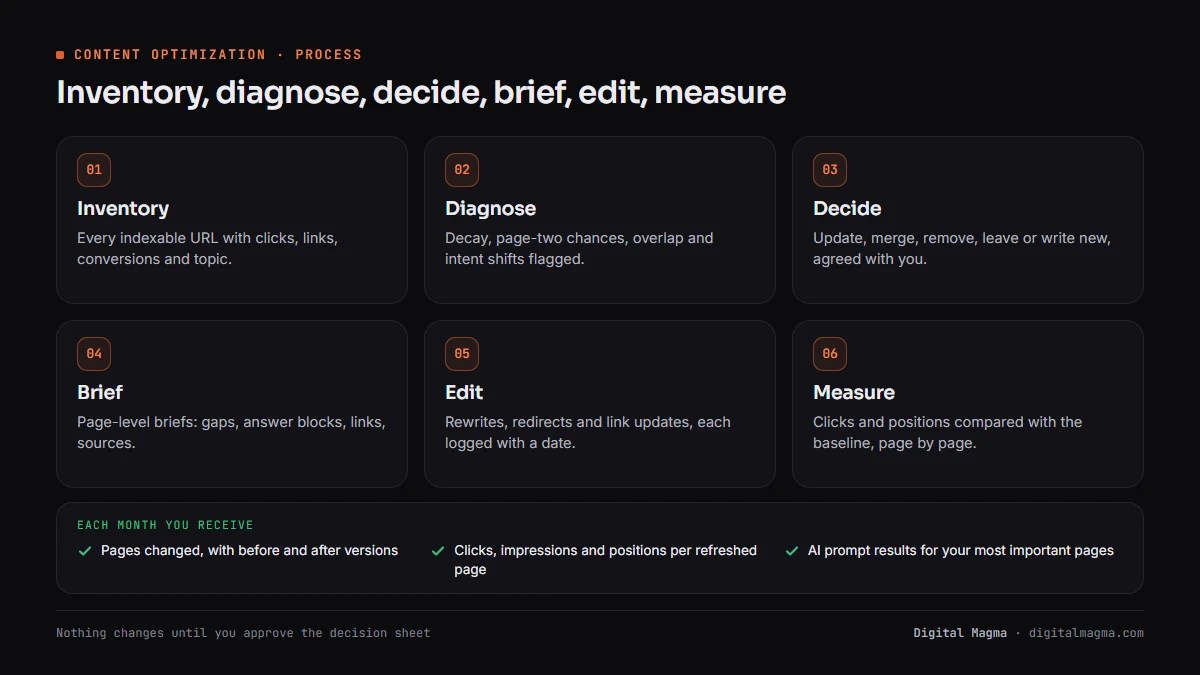
Digital Magma runs every refresh through six steps: inventory, diagnosis, decisions, briefs, edits and measurement. The inventory covers every indexable URL, and nothing is changed until you approve the decision sheet. That approval step protects the pages that still earn money while the weak ones are reworked.
Inventory
Every indexable URL with clicks, links, conversions and topic.
Diagnose
Decay, page-two chances, overlap and intent shifts flagged.
Decide
Update, merge, remove, leave or write new, agreed with you.
Brief
Page-level briefs: gaps, answer blocks, links, sources.
Edit
Rewrites, redirects and link updates, each logged with a date.
Measure
Clicks and positions compared with the baseline, page by page.
Each month you receive
- The list of pages changed, with links to before and after versions
- Clicks, impressions and positions for each refreshed page
- AI prompt results for the pages you care about most
Proof
Content optimization results we can show
Content optimization results specific to refreshes are not approved for publication yet, so Digital Magma will not show any. What we can show is content-led SEO work that used the same on-page methods: a Noida software firm at #1 for its main search, and an Indian app company with 500+ page-one keywords.


A software development company in Noida
Content-led SEO
- On-page method
- Nine focused posts aimed at searches that were still rising.
- Read more
- Case study
An app development company from India
Content and international SEO
- On-page method
- International SEO across six country markets.
- Read more
- Case study
A UK tele-oncology startup
Built from scratch
- On-page method
- A new site rebuilt from React to Next.js so pages render for crawlers.
- Refresh data
- None approved yet for publication.
“We hired Digital Magma for social media marketing and SEO services. The engagement on our pages improved, and our website traffic also increased gradually.”
“Their team helped us improve our SEO rankings and manage paid campaigns effectively. Communication was smooth throughout the project, and we saw genuine improvements in inquiries.”
Pricing
Content optimization pricing from ₹40,000 a month
Content optimization pricing at Digital Magma starts from ₹40,000 a month plus GST on Starter, then Growth from ₹40,000, Scale from ₹80,000 and Enterprise from ₹1,20,000, all plus GST. The number of pages refreshed each month and the depth of each rewrite decide the plan, and both are written into the proposal.
| Plan | From (per month) | Typical site | Refresh scope |
|---|---|---|---|
| Starter | ₹40,000 + GST | Under 50 pages | A few priority pages refreshed each month |
| Growth | ₹60,000 + GST | Blogs of 50 to 200 posts | More pages, plus pruning and merges |
| Scale | ₹80,000 + GST | 200 to 1,000 pages | Full inventory, cannibalization clean-up |
| Enterprise | ₹1,20,000 + GST | Large publishers and catalogues | Agreed in the proposal |
Page counts per plan are fixed in your proposal. Begin with a free SEO audit request.
Agency services, scoped to your requirements. Monthly work or standalone projects as agreed. Applicable taxes and ad spend are separate.
Engagement options for refresh work
Digital Magma runs refresh work in four formats. Larger blogs often start with a one-off clean-up, then keep a smaller monthly refresh going.
| Format | Ideal for | Deliverable | Basis |
|---|---|---|---|
| Monthly refresh | Sites that publish regularly | A set number of pages improved each month | From ₹40,000 a month + GST |
| One-off clean-up | Large, untidy blogs | Inventory, merges, redirects and key rewrites | Project quote |
| Content audit | Teams with their own writers | The decision sheet and page briefs | Fixed quote |
| Editing support | In-house content teams | Review of drafts before they go live | Monthly quote |
How your service quote is scoped
₹40,000 is our minimum paid engagement, not a fixed price for every service or a promise that every deliverable is included. For this service, the quote depends on website size, technical complexity, locations and languages, content production, authority work and SEO or AI-search reporting.
Recurring work is quoted per month; a standalone audit, build or production project is quoted separately. Your proposal confirms deliverables, quantities, timelines, revisions, applicable taxes and third-party costs before work begins. Larger programmes are custom quoted with no upper price limit.
Options
Content optimization vs content writing vs a scoring tool
Content optimization, content writing and scoring tools solve different problems. Writing adds new pages. A scoring tool suggests terms for one page at a time. Digital Magma’s refresh work decides which existing pages to update, merge or remove, then improves them using your own performance data.
| Question | Content writing | Scoring tool | Refresh service (Digital Magma) |
|---|---|---|---|
| Works on | New pages | One page at a time | The whole existing library |
| Uses your Search Console data | Sometimes | Some tools | Always |
| Merges and redirects | No | No | Yes |
| Cannibalization fixes | No | No | Yes |
| AI answer checks | Rarely | Some tools | Monthly |
Honest advice
Content optimization or new content: when writing new pages wins
Refreshing old pages is not always the right call, and Digital Magma says so when the data points elsewhere. A young site with few pages has little to optimize. A new service needs its own page. A topic your old post only touched in passing deserves a fresh article, written for today’s intent.
| Situation | Better move |
|---|---|
| Fewer than 20 indexed pages | Plan and write the missing core pages |
| A new product or service | A dedicated new page |
| Traffic fell overnight across the site | A technical or penalty check first |
| No keyword plan behind the content | Research first, then refresh against the map |
For a sudden site-wide fall, see Google penalty recovery. For planning, see keyword research.
Content optimization agency recognition
Further Digital Magma awards will be shown here after each one’s photo and details are checked.

FAQs
SEO content optimization: questions buyers ask
What is content optimization in SEO?
Content optimization in SEO is improving existing pages so they match search intent, answer questions clearly and earn clicks.
It includes titles, headings, internal links, trust signals and decisions to merge or remove weak pages.
How is content optimization different from content writing?
Writing creates new pages. Optimization improves the ones you have.
Many sites gain more from fixing fifty old posts than from adding fifty new ones, because the old pages already have history with Google.
How do I know which pages to update first?
Start in Search Console. Pages averaging positions 11 to 20 with steady impressions are the quickest wins.
Next come pages whose clicks fell across two equal periods, especially if they once brought leads.
Will updating old content hurt my rankings?
It can if you change the URL, strip out what ranked, or remove sections that answered key questions.
We keep URLs, preserve working sections and log every edit, so any change can be reversed.
Should I delete old blog posts with no traffic?
Sometimes. If a post has no traffic, no links and no business value, removing it with a redirect to a related page is reasonable.
If it has links or answers customer questions, update or merge it instead.
How much do content optimization services cost?
Digital Magma’s plans start from ₹40,000 a month plus GST.
Growth, Scale and Enterprise plans start from ₹40,000, ₹80,000 and ₹1,20,000 a month. A one-off clean-up of a large blog is quoted separately.
How long after updating does a page move in rankings?
It varies by site and topic. Google has to recrawl the page first, which you can request through the URL Inspection tool.
We compare each page against its baseline monthly and report the movement honestly.
How do I make content easier for AI tools to quote?
Open each section with a direct answer that makes sense on its own. Name the subject, give the fact, cite a source.
Use tables for comparisons, and keep facts identical across your site.
Do content optimization tools like Surfer or Clearscope help?
They help spot missing sub-topics by comparing your page with top results.
They cannot judge intent shifts, cannibalization or whether a page should exist at all, so we use them as a checklist.
Related
Content optimization related services and guides
Refresh work sits between research and writing, so Digital Magma links it to both. Keyword research decides which queries each page should own, content writing fills the gaps refreshes cannot, and entity work keeps names and facts consistent. The guides below cover E-E-A-T and AI citation in more depth.
SEO services
Every search service we run.
Keyword research
The map behind each page (page coming soon).
Content writing
New pages from scratch.
Entity SEO
Consistent facts about your brand (page coming soon).
Link building
Links to the pages you refresh (page coming soon).
E-E-A-T
What Google means by trust.
AI citation
How AI answers pick sources.
Content AI can quote
Writing passages that stand alone.
Author
Content optimization guide author: Ankit Sachan
Ankit Sachan, who founded Digital Magma and heads its SEO work, wrote this guide. He has spent more than ten years in search and digital marketing, and he sets the strategy on the agency’s refresh projects for companies in India and abroad.
Ankit Sachan
Founder & Head of SEO, Digital Magma
He has 10+ years in search, 100+ projects and clients across six countries and 10+ industries.
His main areas are content strategy, technical SEO, and GEO and AEO for AI answers.
Credentials: Google Ads, GA4 and Google Business Profile certified. Last updated 27 October 2026.
Let’s talk
Content optimization that brings old pages back to page one
Share your site with Digital Magma, and Search Console access if you can. We will list the pages losing ground and the ones closest to page one, explain the fix for each on a short call, then send a written proposal with page counts and price.
- A page list of decaying and page-two URLs
- A call on what each page needs
- A proposal with scope and cost
- Call: +91 79823 19697
- Email: contact@digitalmagma.com
- WhatsApp: Start a WhatsApp chat
- Mon–Sat, 9 am–9 pm IST · Sector 137, Noida 201305 · Contact page
Send the URL now. Digital Magma replies with three pages we would put first in a content optimization plan.
Find my decaying pages
Quick to fill in. We never pass your details on.
This site is protected by reCAPTCHA and the Google Privacy Policy and Terms of Service apply.